
Alright, let’s be real for a second—nobody wakes up excited about calculating stairs. But here’s the thing: mess up your staircase measurements, and you’re looking at some seriously expensive problems. We’re talking safety hazards, building code violations, and potentially having to rip everything out and start over. Yikes.
Whether you’re a contractor who’s built a hundred staircases or a DIY weekend warrior tackling your first deck project, a stair calculator is basically your new best friend. It takes all that confusing math (you know, the stuff that makes your head hurt) and spits out exactly what you need to build stairs that are safe, comfortable, and won’t get you slapped with a code violation.
So what does this magical tool actually do? It figures out all the critical dimensions you need—your rise and run for each step, how many steps you’ll need, the total rise and run, and even your stringer length. Basically, it’s like having an engineer in your pocket, minus the hefty consulting fee.
In this guide, I’m going to walk you through everything you need to know about using a stair calculator, understanding the science behind comfortable stairs, staying on the right side of building codes, and avoiding those facepalm-worthy mistakes that can cost you big time. Let’s dive in!
- Your Interactive Stair Calculator: Let's Get Building
- The Secret Science Behind Comfortable Stairs
- Building Code Compliance: The Non-Negotiables
- Step-by-Step: Using Your Stair Calculator Like a Pro
- Pro Tips and Mistakes to Avoid (Learn From Others' Pain)
- Your Most Common Questions Answered
- Wrapping This Up: Build Stairs You Can Be Proud Of
Your Interactive Stair Calculator: Let’s Get Building
Okay, before we get into all the nerdy details, let’s talk about how to actually use this thing. Your stair calculator needs a few key measurements from you:
Total Rise: This is the vertical distance you’re covering—basically from your bottom finished floor to your top finished floor. And yeah, I said finished floor because forgetting about that extra inch of tile or hardwood is a classic mistake.
Available Run Space: How much horizontal real estate do you have to work with? Measure the total distance your stairs can extend into the space.
Desired Tread Depth or Riser Height: Some calculators let you choose what you want—either how deep you want each step (the tread) or how tall you want each riser to be.
Advanced Settings: Want to get fancy? You can usually toggle between inches and metric, and choose your stringer mount type (standard or flush mount).
Just punch in your numbers, and boom—the calculator does all the heavy lifting for you.
The Secret Science Behind Comfortable Stairs
Here’s something most people don’t know: there’s actually a formula for comfort when it comes to stairs. It’s not just random—there’s legit science behind why some stairs feel natural and others make you feel like you’re climbing Mount Everest.
The 2R + T Formula (AKA The Golden Rule)
Ready for some quick math? Don’t worry, it’s painless. The golden rule is: 2R + T should equal between 24 and 26 inches.
What does that mean? R is your riser height (how tall each step is), and T is your tread depth (how deep each step is). So if you multiply your riser height by two and add your tread depth, you should land somewhere around 25 inches for maximum comfort.
Example time: If you’ve got 7-inch risers and 11-inch treads, that’s (2 × 7) + 11 = 25 inches. Perfect! This is pretty much the sweet spot that feels natural to walk on. Your legs just know what to do without thinking about it.
The Basic Formulas (Don’t Worry, I’ll Explain)
Here’s how to calculate stair stringers and all the other important stuff:
Number of Risers = Total Rise ÷ Desired Riser Height
If you’re going up 105 inches and want 7-inch risers, you’d need exactly 15 risers. Easy, right?
Actual Riser Height = Total Rise ÷ Number of Risers
This is where it gets real. Most of the time, your initial division won’t work out perfectly, so you divide your total rise by the actual number of risers you’ll build to get the precise height each one should be.
Stringer Length = √(Total Rise² + Total Run²)
kay, this one looks scary, but it’s just the Pythagorean theorem from high school. Your stair calculator handles this automatically, figuring out exactly how long to cut your stringers.
Building Code Compliance: The Non-Negotiables
Look, I know building codes sound boring, but ignoring them is a terrible idea. Not only could you fail inspection, but you could also be creating a genuinely dangerous situation. Nobody wants Uncle Bob eating it on Thanksgiving because your risers are too tall.
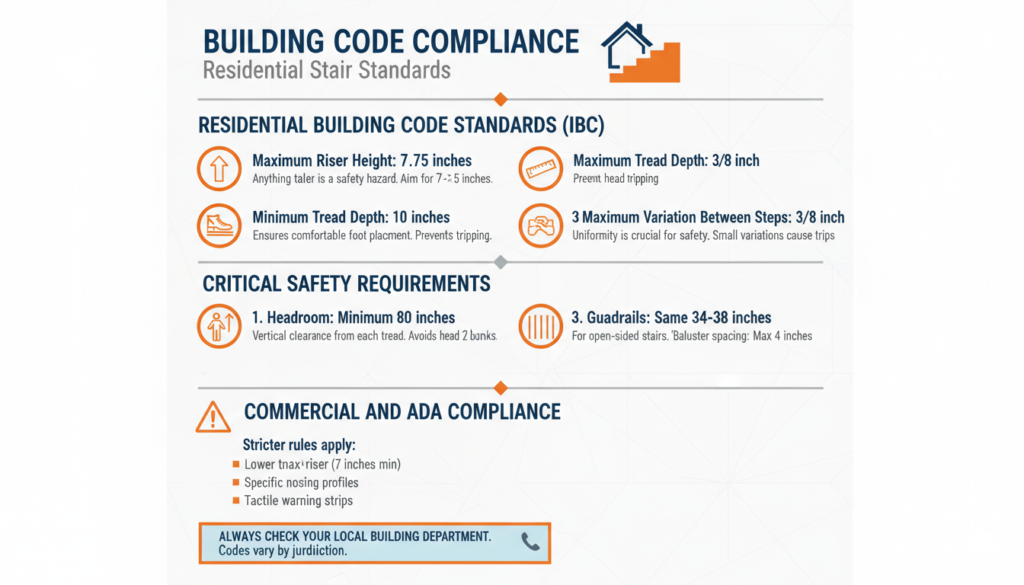
Residential Building Code Standards (IBC)
Let me break down the important stuff you absolutely cannot ignore:
Maximum Riser Height: 7.75 inches
This is huge. Anything taller than 7.75 inches isn’t just uncomfortable—it’s against code and honestly dangerous, especially for kids and older folks. Most pros aim for 7 to 7.5 inches to stay comfortably under this limit.
Minimum Tread Depth: 10 inches
Your treads (the part you step on) need to be at least 10 inches deep, measured from nosing to nosing. Go smaller, and people’s feet won’t fit comfortably, making your stairs a tripping hazard.
Maximum Variation Between Steps: 3/8 inch
Here’s where precision matters. All your risers need to be within 3/8 inch of each other. Even small variations can cause people to trip because their brain expects each step to be identical.
Critical Safety Requirements
Headroom: Minimum 80 inches
Nobody wants to bonk their head, right? You need at least 80 inches (6 feet 8 inches) of clearance measured vertically from the nosing of each tread.
Handrails: 34 to 38 inches high
Handrails aren’t optional—they’re required for any stairway with four or more risers. They should be between 34 and 38 inches above the nosing, and they need to be “graspable,” meaning between 1.25 and 2 inches in diameter.
Guardrails: Same 34 to 38 inches
If your stairs are open on the sides, you need guardrails (also called balusters). The spacing between balusters can’t be more than 4 inches—this prevents small children from squeezing through or getting their heads stuck.
Commercial and ADA Compliance
If you’re building commercial stairs or need ADA compliance, the rules get stricter. Commercial code often requires:
- Deeper treads (typically 11 inches minimum)
- Lower maximum riser height (often 7 inches max)
- Specific nosing profiles
- Tactile warning strips at the top and bottom
Always check your local building department because codes can vary by jurisdiction. Seriously, make that phone call—it’ll save you headaches later.
Step-by-Step: Using Your Stair Calculator Like a Pro
Alright, let’s walk through this process together. Using a stair calculator is straightforward once you know the tricks.
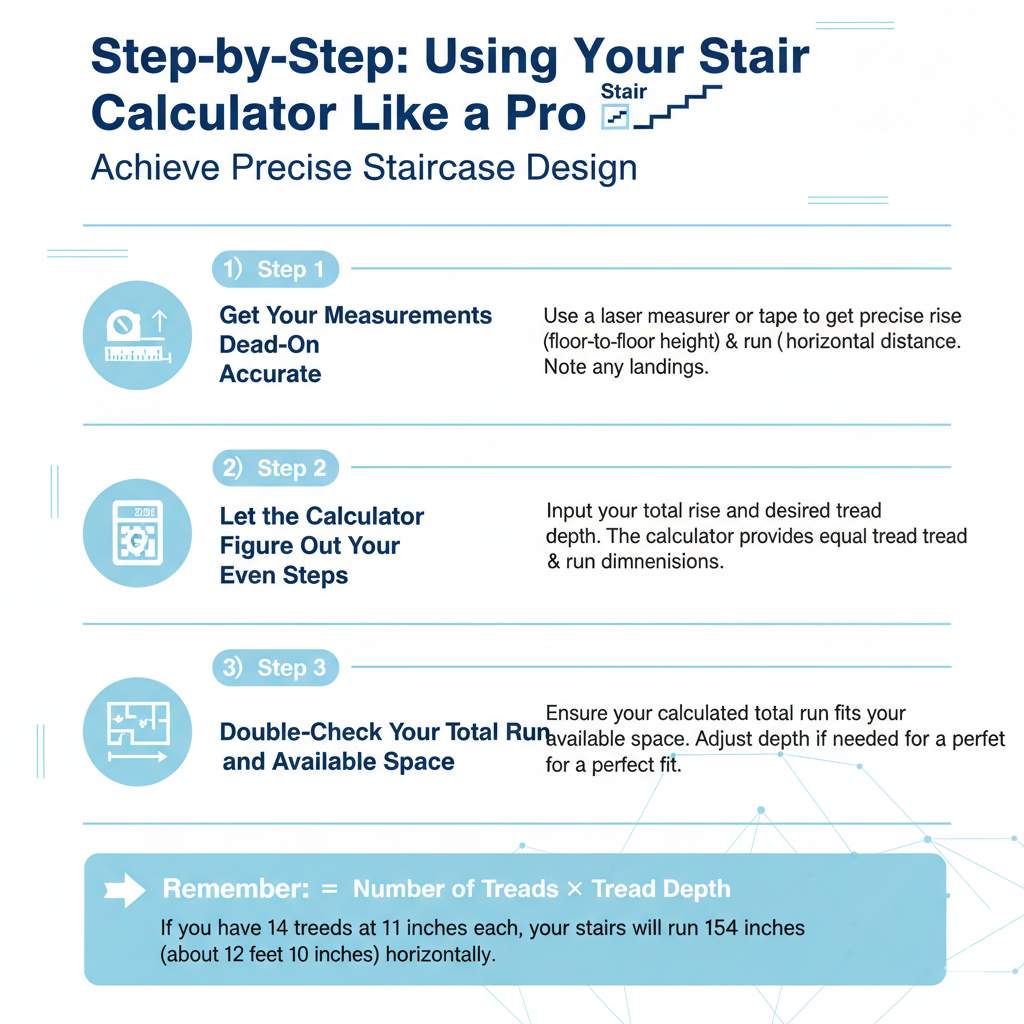
Step 1: Get Your Measurements Dead-On Accurate
This is where most mistakes happen, so pay attention! You need to measure from finished floor to finished floor—not subfloor to subfloor.
What does that mean? If you’re adding carpet, tile, hardwood, or any other flooring material, include its thickness in your measurement. Forgetting that extra inch can throw off your entire calculation, leaving you with one weird step that’s a different height from the rest.
Pro tip: Use a laser level or a long straight edge with a level to get the most accurate vertical measurement. Measure in multiple spots to account for any slope in your floors.
Step 2: Let the Calculator Figure Out Your Even Steps
Here’s where the magic happens. You plug in your total rise, and the calculator tells you how many risers you need and what their exact height should be.
Let’s say your total rise is 105 inches and you want 7-inch risers. Divide 105 by 7, and you get exactly 15 risers. Perfect! But life isn’t usually that clean.
What if your total rise is 108 inches? 108 ÷ 7 = 15.43 risers. Well, you can’t have .43 of a riser, so you’d round to 15 risers. Now divide 108 by 15, and you get 7.2 inches per riser. That’s your actual riser height.
But wait—there’s a trick many pros use. Since you typically have one fewer tread than you have risers (the top “landing” counts as the final tread), some builders adjust the bottom riser slightly to make the math work out perfectly. Your stair calculator usually handles this automatically.
Step 3: Double-Check Your Total Run and Available Space
Once the calculator gives you your total run (the horizontal distance your stairs will cover), make absolutely sure it fits your available space. If it doesn’t, you’ll need to adjust something—either find more space, increase your riser height (within code limits), or get creative with your design.
Remember: Total Run = Number of Treads × Tread Depth. If you have 14 treads at 11 inches each, your stairs will run 154 inches (about 12 feet 10 inches) horizontally.
Pro Tips and Mistakes to Avoid (Learn From Others’ Pain)
I’ve seen a lot of stair projects over the years, and certain mistakes pop up again and again. Let me save you some trouble.
Common Mistake #1: Forgetting Floor Finishes
I mentioned this earlier, but it’s worth repeating because it’s such a common screw-up. That half-inch of carpet padding or three-quarter-inch hardwood makes a real difference. Measure to your finished floor height, or you’ll end up with one step that’s noticeably different from the rest—and that’s exactly how people trip.
Common Mistake #2: Oversized Risers
Look, I get it—you want to use fewer steps to save materials or fit into a tight space. But risers over 7.75 inches are not only against code, they’re genuinely uncomfortable and unsafe. If your calculation is giving you risers that are too tall, you need to rethink your approach. Maybe add another riser or reconsider the project entirely.
Common Mistake #3: Ignoring Local Code Variations
The IBC (International Building Code) provides baseline standards, but your local jurisdiction might have additional requirements. Some cities require inspections at specific stages of construction. Some have different snow load or wind load requirements that affect structural calculations.
Before you cut a single board, visit your local building department or check their website. Get the actual requirements in writing. Trust me, spending an hour researching codes is way better than failing inspection and having to redo everything.
Common Mistake #4: Nominal vs. Actual Lumber Dimensions
Here’s a fun fact that trips up beginners: a 2×12 board isn’t actually 2 inches by 12 inches. It’s 1.5 inches by 11.25 inches. These are called “nominal” versus “actual” dimensions.
Why does this matter when you’re figuring out how to calculate stair stringers? Because if you’re designing your stairs based on nominal dimensions, your cuts won’t fit properly. Always use actual lumber dimensions in your calculations.
Structural Considerations You Can’t Ignore
Your stairs need to be strong enough to support people safely. Residential stairs must support a minimum live load of 40 pounds per square foot. That’s the weight of people walking on them—it doesn’t include the weight of the structure itself (the “dead load”).
For most residential applications, 2×12 stringers spaced 16 inches apart are standard and more than adequate. For wider stairs or higher traffic commercial applications, you might need 3 stringers or even more, plus heavier lumber.
When to Call in the Experts
Look, stair calculators are awesome for straightforward, standard stairs. But some projects need professional help:
Spiral Stairs: These require completely different calculations involving radius, degrees of rotation, and triangular treads. Don’t DIY this unless you really know what you’re doing.
U-Shaped or L-Shaped Stairs with Landings: The landings themselves need proper structural support, and calculating the turns requires understanding three-dimensional geometry.
Exterior Stairs with Significant Weather Exposure: Frost lines, drainage, structural attachment to buildings—these all add complexity that goes beyond simple rise and run calculations.
Historic Renovations: Older buildings often have non-standard dimensions and may require custom solutions that match existing architecture.
If your project involves any of these, it’s worth consulting with a structural engineer or experienced stair builder. Yeah, it costs money upfront, but it’s way cheaper than fixing a failed DIY attempt.
Your Most Common Questions Answered
Let’s tackle the questions people ask most often about stair calculators and stair construction.
What is the maximum riser height allowed by building code?
For residential construction following IBC standards, the maximum riser height is 7.75 inches (about 196mm). Going higher than this isn’t just uncomfortable—it creates a genuine safety hazard and will fail inspection. Most experienced builders aim for 7 to 7.5 inches to stay safely under the limit while maximizing comfort.
How does the 2R + T formula ensure comfort?
The 2R + T formula (twice the riser height plus the tread depth equals 24-26 inches) is based on the natural stride length and gait of average adults. It ensures that the relationship between how high you lift your foot and how far forward you step matches your body’s natural movement. When stairs follow this formula, you don’t have to think about your steps—your body just knows what to do. Stairs that violate this formula feel awkward and tiring, and they’re more likely to cause trips and falls.
Can I use a stair calculator for outdoor stairs?
Absolutely! The basic principles of rise, run, and comfortable stair geometry apply whether you’re building indoors or outdoors. However, outdoor stairs have some additional considerations your stair calculator might not address:
- Slope for water drainage (typically 1/4 inch per foot)
- Frost depth and footing requirements in cold climates
- Weather-resistant materials and fasteners
- Non-slip tread surfaces
- More aggressive nosings for rain runoff
So yes, use the calculator for your basic dimensions, but research the specific requirements for exterior construction in your climate zone.
What are the ADA compliance requirements for stairs?
ADA (Americans with Disabilities Act) standards are stricter than basic residential code:
- Riser heights between 4 and 7 inches (yes, there’s both a maximum AND minimum)
- Uniform riser heights—all risers must be identical
- Tread depths of 11 inches minimum
- Handrails on both sides, continuous along the entire run
- Handrail extensions at the top and bottom (12 inches beyond the first and last risers)
- Contrasting tread nosing strips for visual identification
- Tactile warning surfaces at the top landing
If you’re building for public access or commercial use, you need to meet ADA standards. Don’t guess—consult with an ADA compliance specialist or experienced commercial contractor.
How accurate are online stair calculators for complex designs?
or straight-run stairs (the simplest type), online stair calculators are extremely accurate—often more accurate than manual calculations because they eliminate human math errors.
For slightly more complex stairs with a single landing, most good calculators can handle it if you break the project into two separate straight runs.
However, calculators become less reliable for:
- Spiral or curved stairs
- Winding stairs with pie-shaped treads
- Custom geometric designs
- Stairs with structural constraints that require engineering analysis
For these complex designs, you really need specialized software (like StairDesigner or CAD programs with stair modules) or consultation with a professional stair builder or structural engineer. The calculator gets you in the ballpark, but complex projects need expertise to ensure safety and code compliance.
Wrapping This Up: Build Stairs You Can Be Proud Of
So there you have it—everything you need to know about using a stair calculator to design and build stairs that are safe, comfortable, and code-compliant.
Here’s the bottom line: a properly calculated staircase isn’t just about meeting code requirements or avoiding inspection failures (though those are definitely important). It’s about creating something people can use safely every single day without even thinking about it. Good stairs just work—they feel natural, they’re comfortable, and nobody trips on them.
Whether you’re a professional contractor bidding on a project or a homeowner planning a deck addition, taking the time to calculate everything correctly on the front end saves you massive headaches later. Measure twice (or three times), use your calculator, double-check against code requirements, and don’t be afraid to ask for help on complex projects.