
Look, let’s be real for a second. You know what separates people who crush their fitness goals from those who just kinda… exist at the gym? It’s not doing more reps or spending three hours on the treadmill. It’s all about exercise intensity—basically, how hard you’re actually working.
Here’s the thing though: intensity is like Goldilocks’ porridge. Too hard, and you’re looking at injuries, burnout, and that awful feeling of dreading your next workout. Too easy, and you’re basically just going through the motions without seeing real results (been there, done that, bought the overpriced gym membership).
So what’s the solution? Enter the Heart Rate Workout Calculator and the whole concept of training zones. Think of it as your personal GPS for fitness—it tells you exactly how hard to push without going overboard. And the best part? You can combine it with some simple checks like the Talk Test and Rating of Perceived Exertion (RPE) to make sure you’re hitting that sweet spot.
Quick Definitions (because nobody likes feeling confused):
- Exercise Intensity: How hard your body’s working during exercise
- MHR (Maximum Heart Rate): The highest your heart rate can go
- HRR (Heart Rate Reserve): The difference between your max and resting heart rates
The Science Stuff (Don’t Worry, We’ll Keep It Simple)
Why Your Heart Rate is Actually Pretty Smart
Okay, so why are we so obsessed with heart rate anyway? Well, tracking your heart rate during a workout is honestly one of the easiest ways to know if you’re working hard enough—or maybe too hard. The cool thing is that your heart rate has this tight relationship with how much oxygen you’re using, which is basically the gold standard for measuring exercise intensity.
And it’s not just us fitness nerds saying this. The American College of Sports Medicine (ACSM)—you know, the actual experts—totally backs heart rate training. So yeah, we’re in good company here.
Let’s Calculate Your Personal Numbers
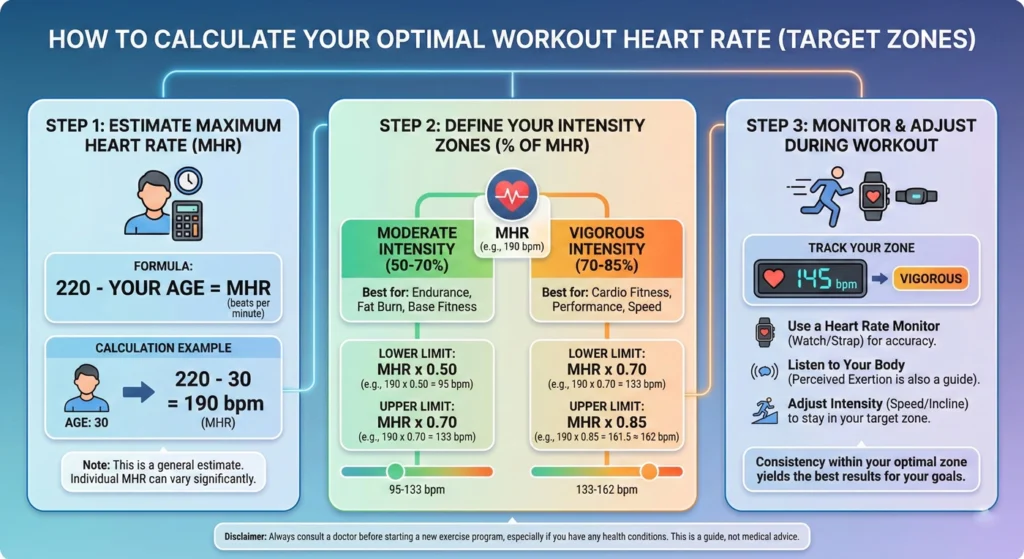
Step 1: Figure Out Your Maximum Heart Rate (MHR)
Alright, time to bust out some basic math. Don’t panic—it’s easier than splitting a dinner bill.
The classic formula everyone knows is: MHR = 220 – Your Age
So if you’re 30, that’s 220 – 30 = 190 beats per minute. Easy peasy, right? But here’s the catch: this formula is super general and might lowball your actual max, especially if you’re in decent shape.
Want something more accurate? Try the Tanaka Formula: MHR = 208 – (0.7 × your age)
For our 30-year-old example, that’s 208 – 21 = 187 bpm. This one tends to work better for fit folks or anyone in their middle years.
Now, if you really want to nail down your exact max heart rate, you’d need to do a medically supervised stress test (like the Bruce protocol). But honestly? For most of us, the formulas work just fine as a starting point.
Step 2: Check Your Resting Heart Rate (RHR)
Your resting heart rate is basically what your heart’s doing when you’re completely chilled out. Lower is generally better here—it means your heart’s become super efficient and doesn’t need to work as hard.
How to measure it properly:
- Do it first thing in the morning, before you’ve even rolled out of bed
- Skip the coffee first (I know, I know)
- Take it over several days and average it out
Pro tip: Some fitness trackers measure your heart rate while you’re actually sleeping, which research shows is even more accurate than the whole “lying awake in bed” method. Science is cool like that.
The Karvonen Formula: Your New Best Friend
Now we’re getting to the good stuff. The Heart Rate Reserve (HRR) method—also called the Karvonen formula—is what how to calculate optimal workout heart rate properly. It’s more personalized than just using a percentage of your max heart rate because it factors in your resting heart rate too.
Here’s the breakdown:
- Heart Rate Reserve (HRR) = MHR – RHR
- Target Heart Rate (THR) = (HRR × % Intensity) + RHR
Let’s make this real. Say you’re 30 with an MHR of 190 and RHR of 60:
- Your HRR = 190 – 60 = 130
- For a 70% intensity workout: (130 × 0.70) + 60 = 151 bpm
That’s your target! See? Not so scary.
The 5 Heart Rate Training Zones (Your Fitness Roadmap)
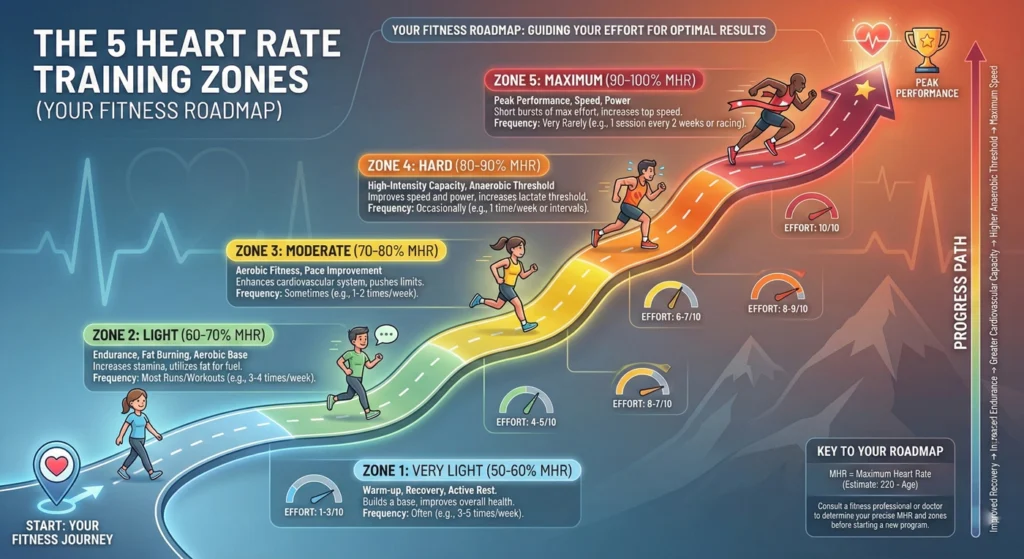
Okay, this is where things get really useful. Think of these zones like gears on a bike—each one has a specific purpose and feel.
Zone 1: Very Light Intensity (50-60% of HRR)
What’s it good for? Recovery days, warming up, cooling down, basically anything where you’re just getting the blood flowing without really pushing it.
What does it feel like? Honestly, it’s so easy you could have a full-on conversation—or even sing along to your workout playlist without gasping for air. On the RPE scale, we’re talking 7-9 (very, very light).
When to use it: Your 5-10 minute warm-up before the real work starts, cool-down after a tough session, or those recovery runs after leg day when you can barely walk.
Zone 2: Light/Aerobic Base (60-70% of HRR)
What’s it good for? This is your fat-burning zone, baby! Your body’s using fat as its main fuel source here, plus you’re building that cardiovascular foundation. It’s also great for your mitochondria (your cells’ little power plants).
What does it feel like? Comfortable enough that you can speak in complete sentences, though your breathing’s a bit heavier than normal. RPE around 11 (fairly light).
When to use it: Long, slow distance runs. Perfect for beginners and anyone trying to lose weight. Most of your training should probably be here, honestly.
Zone 3: Moderate/Tempo (70-80% of HRR)
What’s it good for? Improving your aerobic fitness, making your heart more efficient, helping your body deal with lactate better, and increasing your stroke volume (how much blood your heart pumps per beat).
What does it feel like? Now you’re working. You can still talk, but only in short phrases. Think RPE 13 (somewhat hard).
When to use it: Tempo runs, marathon pace training, or when you’re doing steady cardio that makes you feel like you’re actually working.
Zone 4: Hard/Lactate Threshold (80-90% of HRR)
What’s it good for? Pushing your anaerobic threshold, boosting your VO₂ max (your body’s maximum oxygen usage), and building speed and power.
What does it feel like? This is tough. You can maybe grunt out one or two words before needing to breathe. RPE 15-16 (hard).
When to use it: Interval training, racing at 5K-10K pace. Keep these efforts short—your body can’t sustain this for long.
Zone 5: Maximum Effort/Peak (90-100% of HRR)
What’s it good for? Developing peak power and speed, maxing out that VO₂.
What does it feel like? All-out, can’t-talk-at-all effort. You’re giving everything you’ve got. RPE 17-20 (very hard to maxing out).
When to use it: Short sprint intervals (like 10-30 seconds), when you’re doing max power work. This isn’t sustainable—it’s about short bursts of absolute effort.
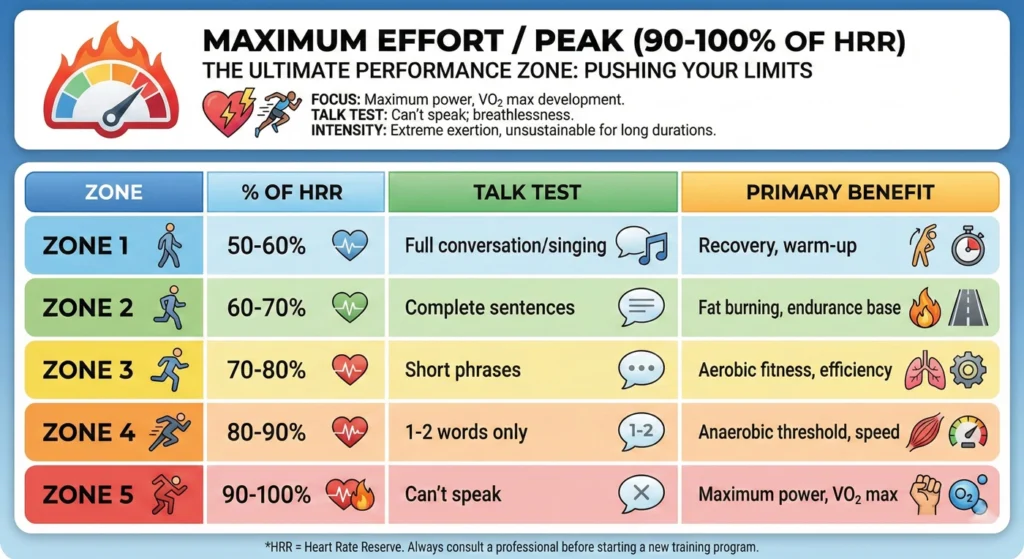
Quick Reference Table
| Zone | % of HRR | Talk Test | Primary Benefit |
|---|---|---|---|
| 1 | 50-60% | Full conversation/singing | Recovery, warm-up |
| 2 | 60-70% | Complete sentences | Fat burning, endurance base |
| 3 | 70-80% | Short phrases | Aerobic fitness, efficiency |
| 4 | 80-90% | 1-2 words only | Anaerobic threshold, speed |
| 5 | 90-100% | Can’t speak | Maximum power, VO₂ max |
Beyond Just Heart Rate: The Bigger Picture
Don’t Just Look Through the Keyhole
Here’s a lesson I learned the hard way: relying on just one measurement is like trying to see a whole room by peeking through a keyhole. You’re missing so much!
The smart move? Combine objective data (your heart rate monitor) with subjective feel (the Talk Test or RPE). Think of it as a system of checks and balances. Sometimes your heart rate says one thing, but your body’s screaming something else entirely.
The Talk Test: Your Built-In Intensity Checker
This one’s dead simple, and honestly, it’s my favorite. Here’s the deal: during your workout, you should be able to get about 3-5 words out per breath while maintaining a comfortable conversation.
Why does this work? It tracks something called your ventilatory threshold (VT)—basically the point where your breathing shifts gears. Once you’re breathing too hard to talk, you’ve crossed over into anaerobic territory, which you can’t maintain for long periods.
The beauty of the Talk Test? It works for everyone, regardless of age or fitness level. Your lungs don’t lie.
The Borg RPE Scale: Trust Your Gut
Rating of Perceived Exertion (RPE) is all about how hard YOU think you’re working. It factors in everything—your physical conditioning, discomfort, breathing, heart rate sensations, the fact that you only had one cup of coffee this morning.
The standard Borg scale goes from 6-20, and for most training, you want to hang out between 11-16.
Translation:
- 11 = Fairly light (you’re cruising)
- 13 = Somewhat hard (definitely working)
- 15-16 = Hard (this is challenging)
The cool thing about RPE? It works just as well whether you’re training solo or in a spin class with 30 other people.
Level Up: Advanced Strategies and Avoiding Dumb Mistakes

The 80/20 Rule (Game-Changer Alert)
If you’re into endurance stuff—running, cycling, triathlons—listen up. The magic formula is spending 80% of your training time in Zones 1-2 (the easier stuff) and only 20% in Zones 3-5 (the hard stuff).
I know, I know. It feels weird to take it easy so much. But this “polarized training” approach prevents burnout, maximizes your aerobic adaptation, and actually improves your long-term performance. The pros do it this way for a reason.
Matching Zones to Your Goals
Trying to lose weight? Focus mainly on Zone 2 for maximum fat burning, but throw in some Zone 4-5 intervals to create that “afterburn effect” (EPOC—excess post-exercise oxygen consumption).
Just want a healthier heart? Build your endurance with Zone 2 work, then add Zone 4 intervals to really strengthen that cardiac muscle.
Common Screw-Ups to Avoid
Mistake #1: Treating formulas like they’re written in stone.
Reality check: The 220-age formula? It’s a starting point, not gospel. Use it as a baseline, then adjust based on how you actually feel (hello, RPE).
Mistake #2: Ignoring outside factors.
Fix: Heat, stress, lack of sleep, that extra espresso shot—they all mess with your heart rate. On a hot day, it’s totally normal to be 5-10 bpm higher. Adjust your targets accordingly.
Mistake #3: The “No pain, no gain” trap.
Truth bomb: Resisting those easy Zone 1-2 workouts because they “don’t feel hard enough” is a fast track to overtraining and burnout. Easy days are when your body actually adapts and gets stronger.
Train Smarter, Not Just Harder
Here’s the bottom line: The Heart Rate Workout approach using the Karvonen method, combined with your own subjective feedback through RPE and the Talk Test, gives you the complete picture. It’s not about grinding yourself into dust—it’s about working at the right intensity for your specific goals.
Whether you’re using a heart rate workout calculator to dial in your zones or just listening to your breathing during a run, you now have the tools to train more effectively.
One last thing (and this is important): If you’re over 45 (guys) or 55 (ladies), or if you’ve got any underlying health stuff going on, chat with your doctor or a certified fitness trainer before diving into vigorous exercise. Better safe than sorry, right?
Now get out there and train smart! Your future, fitter self will thank you.