
Okay, real talk – have you ever Googled “calorie calculator for weight loss” at 2 AM, hoping to find that one magic number that’ll finally make everything click? Yeah, me too. And honestly? Most of the advice out there is pretty useless because it treats everyone like we’re all the same robot with identical energy needs. Spoiler alert: we’re not!
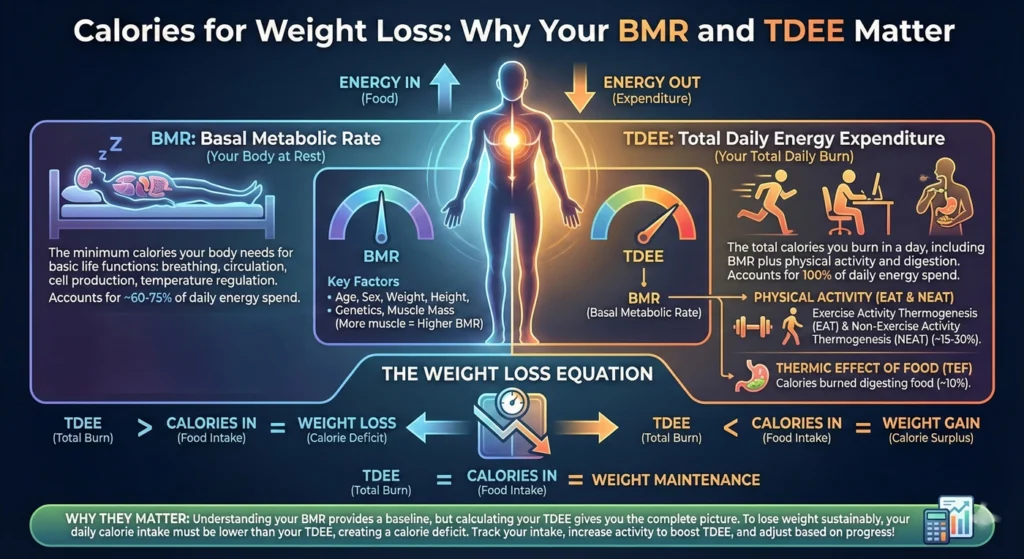
Here’s the thing nobody tells you: your body has its own unique energy signature. It’s like your personal calorie fingerprint. Before you can figure out how many calories for weight loss you actually need, you’ve gotta understand two super important numbers – your BMR (Basal Metabolic Rate) and your TDEE (Total Daily Energy Expenditure).
Think of BMR as your body’s “keep the lights on” cost – it’s the minimum energy your body needs just to exist while binge-watching Netflix. We’re talking basic stuff like keeping your heart beating, your lungs breathing, and your brain doing its thing.
TDEE, on the other hand, is the whole picture – it’s every single calorie you burn throughout the day, including your BMR, that walk to the coffee shop, and even the energy it takes to digest that burrito you had for lunch.
The real secret to figuring out how to calculate calories for weight loss? Nailing down these two numbers first. It’s literally the foundation of everything else.
A quick note: This article is based on actual scientific formulas and expert health insights – not just random internet wisdom. We’re keeping it real with the science stuff, but I promise to make it actually understandable.
- Decoding Your Baseline: What is BMR and Why Should You Care?
- Step 1: Finding the Most Accurate BMR Formula (Without Needing a PhD)
- Step 2: Calculating Your TDEE (The Number That Actually Matters)
- Step 3: Creating Your Weight Loss Deficit (Without Starving Yourself)
- Beyond the Numbers: What Actually Affects Your Metabolism
- Calories vs. Macros: Which Strategy Wins?
- Important Safety Stuff (Please Don't Ignore This Part)
- Take Control of Your Energy (You've Got This!)
Decoding Your Baseline: What is BMR and Why Should You Care?
Alright, let’s break down what BMR actually means without putting you to sleep.
Your Basal Metabolic Rate is basically the number of calories your body torches over 24 hours just to keep you alive while you’re doing absolutely nothing. Like, imagine you’re lying in bed all day (not a bad dream, honestly), completely awake but not moving – that’s your BMR at work. And get this: it makes up about 60-75% of your total daily calorie burn. Pretty wild, right?
So what’s your BMR actually powering? Here’s the rundown:
Your heart’s pumping blood nonstop (thankfully). Your lungs are breathing without you even thinking about it. Your body’s maintaining its temperature so you don’t freeze or overheat. And behind the scenes, your cells are constantly repairing themselves while your brain’s processing everything. All that stuff burns calories even when you’re literally just existing.
BMR vs. RMR: Wait, There’s a Difference?
Okay, quick sidebar because this confuses everyone (including me at first).
BMR is measured in super strict lab conditions. We’re talking fasted state, completely rested, neutral temperature – basically scientific perfection that most of us will never experience unless we’re part of a research study.
RMR (Resting Metabolic Rate) is measured under way more chill conditions and usually comes in about 10% higher than BMR. Here’s the kicker: most “BMR calculators” you find online? They’re actually giving you RMR estimates because that’s more practical for everyday use. Don’t stress about it though – it’s close enough for our purposes!
Step 1: Finding the Most Accurate BMR Formula (Without Needing a PhD)
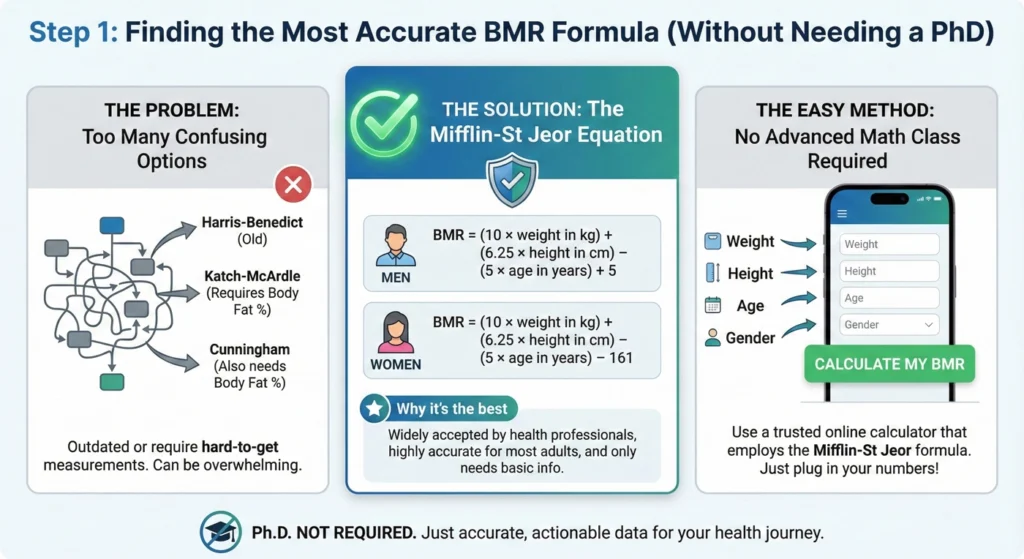
So here’s where it gets interesting. Sure, you could go to a fancy lab and get hooked up to indirect calorimetry equipment (which is literally the gold standard), but let’s be real – most of us aren’t doing that. Instead, we’ve got some pretty solid math formulas that’ll get you close enough.
The Mifflin-St Jeor Formula (The Crowd Favorite)
This is the one that most nutrition experts and even the US Academy of Nutrition and Dietetics recommend for regular folks like us. It’s been around since 1990 and it’s proven to be the most accurate formula for the general population.
Here’s how it works:
For men: BMR = (10 × weight in kg) + (6.25 × height in cm) – (5 × age) + 5
For women: BMR = (10 × weight in kg) + (6.25 × height in cm) – (5 × age) – 161
Yeah, there’s a 166-calorie difference between men and women in the formula. Biology isn’t always fair, I know.
The Katch-McArdle Formula (For the Gym Rats)
Now, if you actually know your body fat percentage or lean body mass (and you’re pretty lean or muscular), this formula might be even more accurate for you:
BMR = 370 + (21.6 × lean body mass in kg)
The catch? You need to know your exact lean body mass, which most people don’t. But if you’ve got that info, this one’s super precise.
The Revised Harris-Benedict Formula (The OG)
This is the older formula that people used to swear by. It’s still decent, but most experts agree that Mifflin-St Jeor is more accurate nowadays. Think of it as the reliable older sibling that got slightly outdated.
Pro Athlete? Here’s Your Special Sauce
Okay, this is a cool unique insight: if you’re an athlete or training like one, research shows that the Cunningham and Harris-Benedict formulas actually work better for you than most other options. Most prediction formulas get wonky when it comes to athletes’ metabolism, but these two tend to show the smallest margin of error. Of course, the real gold standard is still getting your BMR measured with proper equipment, but if that’s not happening, these are your best bets.
Step 2: Calculating Your TDEE (The Number That Actually Matters)
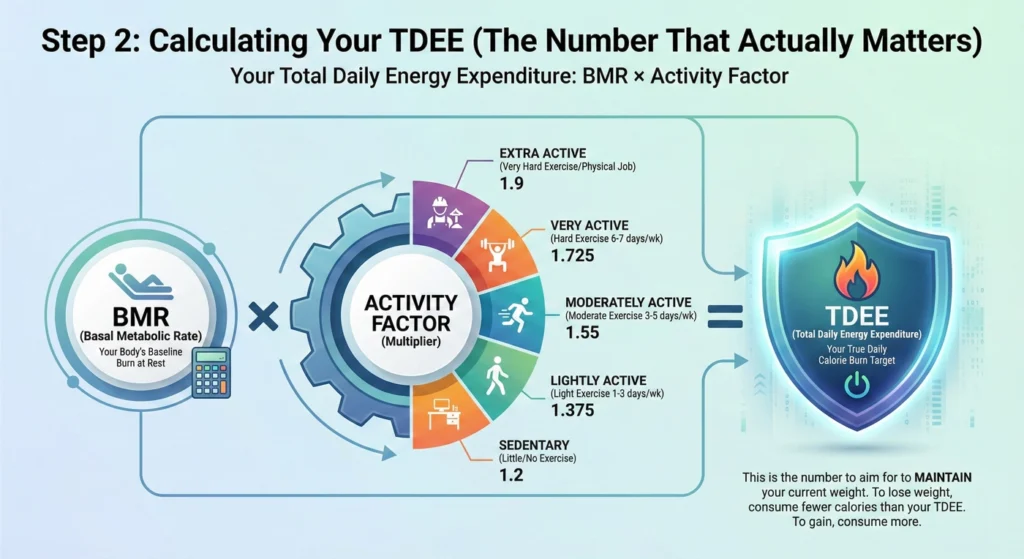
Alright, so you’ve got your BMR – awesome! But here’s the thing: that’s just your baseline. Your TDEE is where the rubber meets the road because it accounts for, you know, actually living your life.
The formula is super simple:
TDEE = BMR × Activity Factor
Here’s how to figure out your activity factor (and be honest with yourself here – we all like to think we’re more active than we actually are):
| Activity Level | Factor | What It Actually Means |
|---|---|---|
| Sedentary | 1.2 | Desk job, mostly sitting, maybe a walk here and there |
| Lightly Active | 1.375 | Light exercise or sports 1-3 days a week |
| Moderately Active | 1.55 | Moderate exercise 3-5 days per week |
| Very Active | 1.725 | Hard exercise 6-7 days a week (you’re basically a machine) |
| Extremely Active | 1.9 | Intense training daily or you have a physically demanding job |
Your TDEE is basically your “maintenance calories” – eat this much, and your weight should stay pretty stable. It’s your personal calorie calculator per day that keeps you right where you are.
Step 3: Creating Your Weight Loss Deficit (Without Starving Yourself)
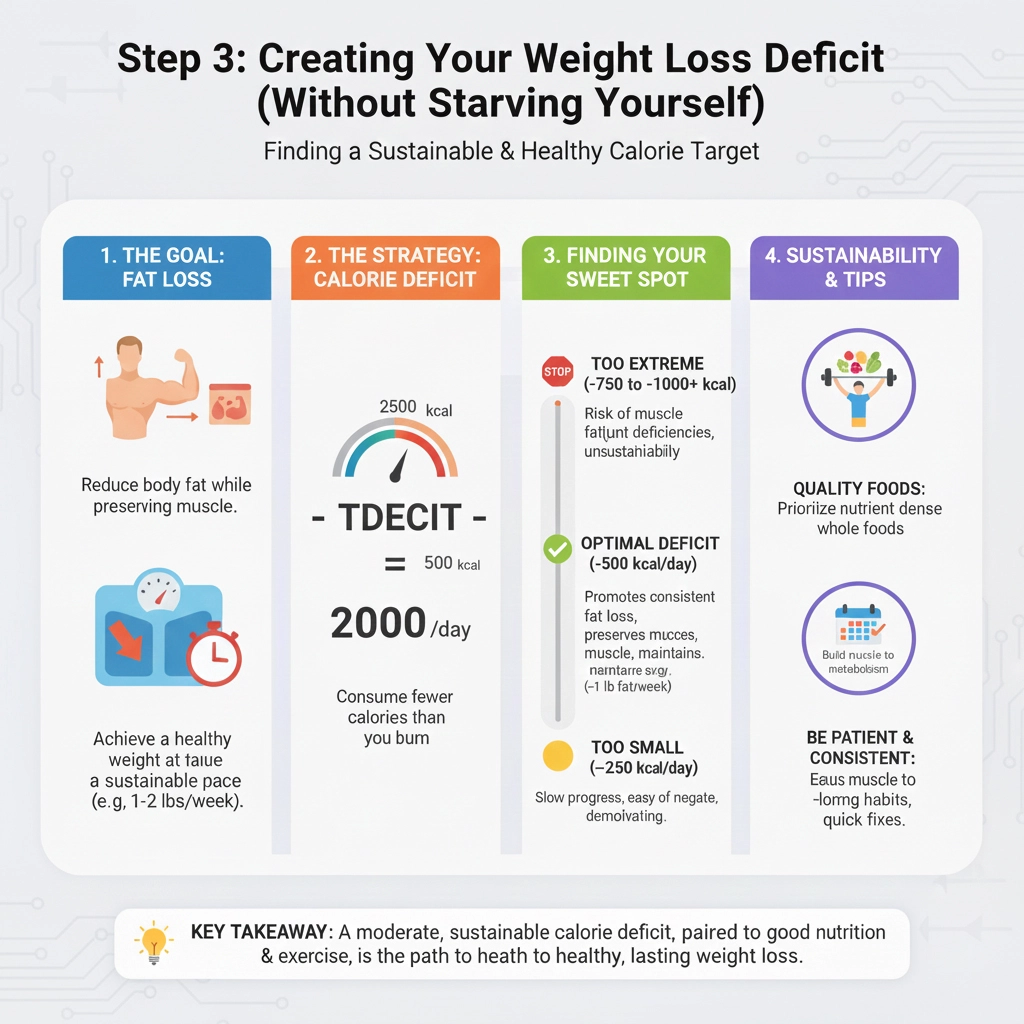
Here’s where we get to the good stuff. To lose weight, you need to eat fewer calories than your TDEE. That’s called a calorie deficit, and it’s literally the only way to lose weight that actually works long-term.
But before you slash your calories to nothing (don’t do that!), here’s what actually works:
The sweet spot for calorie controlled diets for weight loss: Aim for 300-500 calories below your TDEE per day. This should get you losing about 1 pound per week, which sounds slow but is actually super sustainable. Remember, 1 pound of fat equals roughly 3,500 calories, so this math checks out.
The absolute maximum: Don’t go more than 1,000 calories below your TDEE. Losing more than 2 pounds a week sounds tempting, but it’s usually not healthy and – here’s the kicker – it can actually slow down your metabolism. Your body’s smart, and if it thinks you’re starving, it’ll start conserving energy. Not what we want!
Beyond the Numbers: What Actually Affects Your Metabolism
Okay, so calculating calories for weight loss isn’t just about the formulas. There’s other stuff going on that affects how many calories you burn.
Muscle Mass is Your Secret Weapon
Here’s something most people don’t realize: muscle tissue burns way more calories at rest than fat tissue. Like, significantly more. This is why strength training is absolutely crucial if you want to boost your BMR naturally. More muscle = higher baseline calorie burn = you can eat more and still lose weight. Win-win-win!
Age and Gender (Thanks, Biology)
Unfortunately, as we age, our BMR tends to drop. It’s mostly because we naturally lose muscle mass as we get older (unless we’re actively working to maintain it – see why strength training keeps coming up?). And yeah, men typically have higher BMRs than women because they generally have more muscle mass. It’s not fair, but it’s biology.
The Crash Diet Trap
Here’s a major mistake people make: going super low-calorie for extended periods. When you do this, your body literally adapts by slowing down your metabolism to conserve energy. It’s trying to protect you from what it thinks is a famine. So those extreme 1,000-calorie diets? They might work short-term, but they’ll backfire hard in the long run by tanking your BMR.
Sleep and Stress Matter More Than You Think
Real talk: if you’re not sleeping well or you’re constantly stressed out, your metabolism gets all kinds of messed up. Poor sleep and chronic stress mess with the hormones that regulate your appetite and metabolism. So yeah, getting enough z’s and managing stress isn’t just hippie wellness stuff – it actually affects your ability to lose weight.
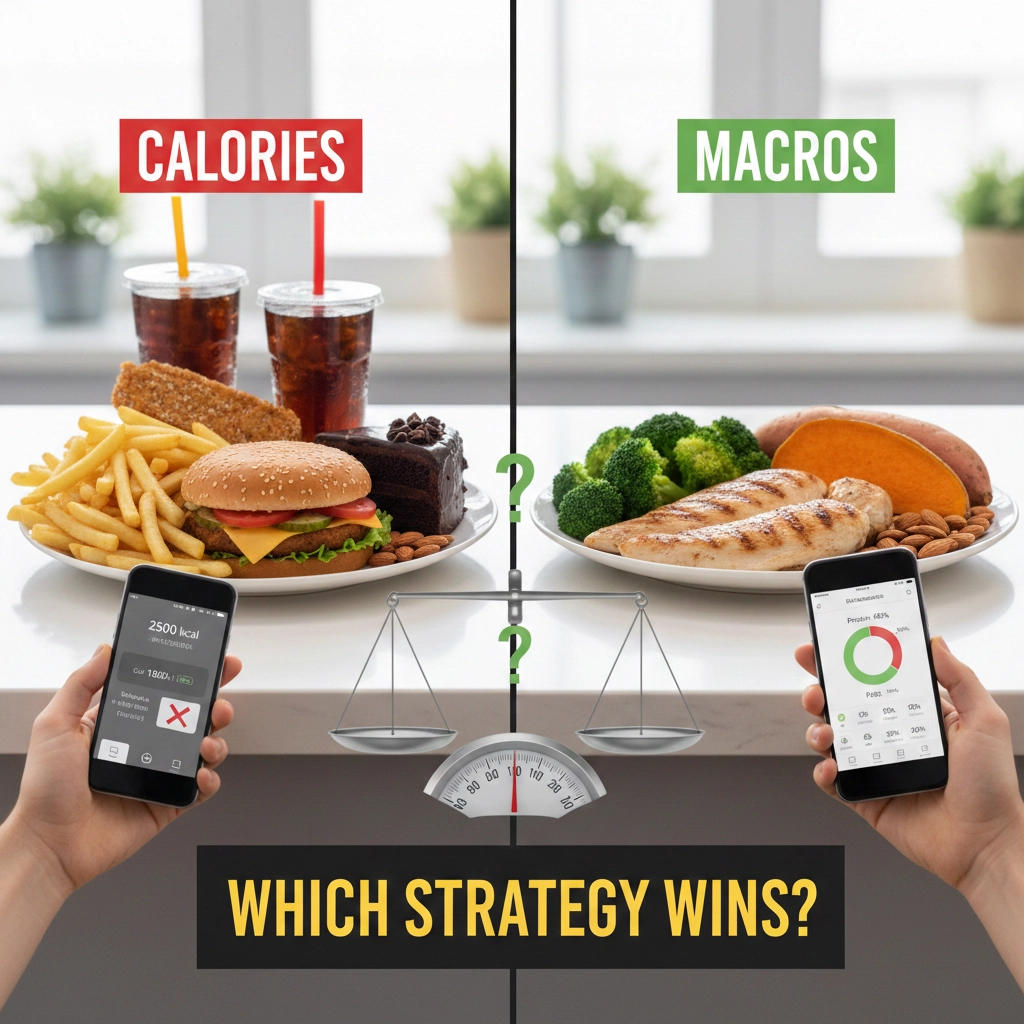
Calories vs. Macros: Which Strategy Wins?
Alright, so you’ve figured out your calorie deficit. Now what? Should you just count total calories, or should you worry about macros (protein, carbs, and fats)?
Calorie counting is straightforward. You just track the total number and try to stay under your target. It’s simple, it’s effective for weight loss, and it’s a great starting point.
Macro counting is next level. Instead of just worrying about the total, you’re paying attention to what those calories are made of. This is super useful for body recomposition – basically losing fat while keeping (or even building) muscle.
Protein is the MVP
If you take away one thing from this section, make it this: protein is absolutely crucial when you’re in a calorie deficit. Aim for about 1.2 grams per kilogram of body weight, or roughly 30% of your total daily calories.
Why? Because protein does two amazing things:
- It helps you maintain lean muscle mass when you’re losing weight (remember, muscle = higher BMR)
- It keeps you feeling full way longer than carbs or fats, making it easier to stick to your deficit
Quality Over Quantity
Look, you could technically lose weight eating nothing but Twinkies if you stayed in a calorie deficit (someone actually did this as an experiment). But you’d feel terrible, lose a ton of muscle, and be constantly hungry.
Instead, focus on nutrient-dense whole foods: lean proteins, complex carbohydrates like whole grains and vegetables, fruits, and healthy fats. Your body will thank you, and you’ll actually have energy to live your life.
The Easiest Win Ever
Want one simple change that’ll make a massive difference? Ditch the sugary drinks. Swap soda, juice, and fancy coffee drinks for water (or sparkling water if you need the fizz). This alone can cut hundreds of empty calories per day, plus staying hydrated actually helps with hunger management. It’s the definition of low-hanging fruit.
Important Safety Stuff (Please Don’t Ignore This Part)
Okay, time for the serious talk. I know everyone wants results yesterday, but there are some real risks to going too extreme with calorie restriction.
Don’t Eat Below Your BMR
Generally speaking, eating significantly fewer calories than your BMR is a bad idea unless you’re under medical supervision. When you go that low, you risk:
- Losing muscle mass (which tanks your metabolism)
- Nutrient deficiencies (your body needs vitamins and minerals to function)
- Hormonal imbalances (especially for women)
- Your metabolism slowing to a crawl
The usual minimums are 1,200 calories per day for women and 1,500 calories per day for men. These aren’t random numbers – they’re based on getting enough nutrients to keep your body functioning properly.
When You Absolutely Need Professional Help
Look, I’m all for DIY and figuring stuff out yourself, but there are times when you really need to consult a registered dietitian or doctor:
- If you have any underlying health conditions (thyroid issues, PCOS, diabetes, etc.)
- If you have a history of eating disorders or disordered eating
- If you’re a competitive athlete with very specific nutritional needs
- If you want a truly personalized meal plan based on your unique situation
Don’t mess around with your health. These professionals exist for a reason.
The Long Game
Here’s the unsexy truth: the best weight loss strategy is the one you can actually stick with long-term. Those crash diets that promise 10 pounds in a week? They don’t work because nobody can sustain them.
Also, your calorie needs aren’t static. As you lose weight, your BMR and TDEE will change. As you get more active (or less active), they’ll change again. Make it a habit to recalculate your needs every 10-15 pounds or whenever your activity level shifts significantly.
Take Control of Your Energy (You’ve Got This!)
Look, I know this was a lot of information. But here’s the bottom line: understanding your BMR and TDEE gives you a personalized roadmap instead of generic “eat 1,200 calories” advice that doesn’t work for everyone.
By using accurate formulas (Mifflin-St Jeor is your friend) and creating a sustainable calorie deficit, you’re setting yourself up for actual success – not the yo-yo diet cycle that leaves you frustrated and right back where you started.
Here’s your action plan:
- Calculate your BMR using the Mifflin-St Jeor formula (or use a reputable online calculator that uses this method)
- Multiply by your honest activity factor to get your TDEE
- Subtract 300-500 calories to create your deficit
- Track your food intake and adjust as needed
- Prioritize protein and whole foods
- Add strength training to build and maintain muscle
Remember, this isn’t about perfection – it’s about progress. Some days you’ll nail it, some days you’ll overshoot your calories, and that’s completely fine. The goal is creating habits you can actually live with.
And honestly? Regular exercise (especially strength training) combined with smart calorie management isn’t just the best path to losing weight – it’s the best path to feeling stronger, more energized, and genuinely healthier.
Now go grab a reputable calorie calculator online, crunch those numbers, and start your journey with actual knowledge backing you up. You’ve totally got this! 💪