
Okay, so here’s a wild stat that’ll probably blow your mind: somewhere between 75% and 80% of women are walking around in the wrong bra size. Seriously! Some experts even say it’s closer to 100% when you factor in all the little fit issues most of us just live with.
And honestly? It’s not even our fault. The whole bra industry has been feeding us outdated measuring techniques for decades, and don’t even get me started on those “professional fittings” at department stores that somehow always end with them trying to squeeze you into whatever they have in stock.
Wearing the wrong size isn’t just annoying—it’s actually a health thing. We’re talking back pain, shoulder grooves from straps doing all the heavy lifting, breast tissue squished in all the wrong places, and that fun feeling where none of your shirts fit quite right. Plus, it can totally mess with your confidence and body image.
But here’s the good news: I’m gonna show you how to calculate bra size at home using the most accurate method out there. No weird adding of random numbers, no pressure to buy anything, just you, a measuring tape, and the truth about what size you actually need. Ready? Let’s do this.
- Section 1: Why Everything You've Been Told About Bra Sizing is Probably Wrong
- Section 2: The Actually Accurate Way to Measure (I Promise It's Not That Hard)
- Section 3: How to Know If Your Bra Actually Fits (The Ultimate Bra Fit Guide)
- Section 4: Next-Level Fitting Tips (Because Bodies Are Complicated)
- Conclusion: Your Best Fit is Out There
Section 1: Why Everything You’ve Been Told About Bra Sizing is Probably Wrong
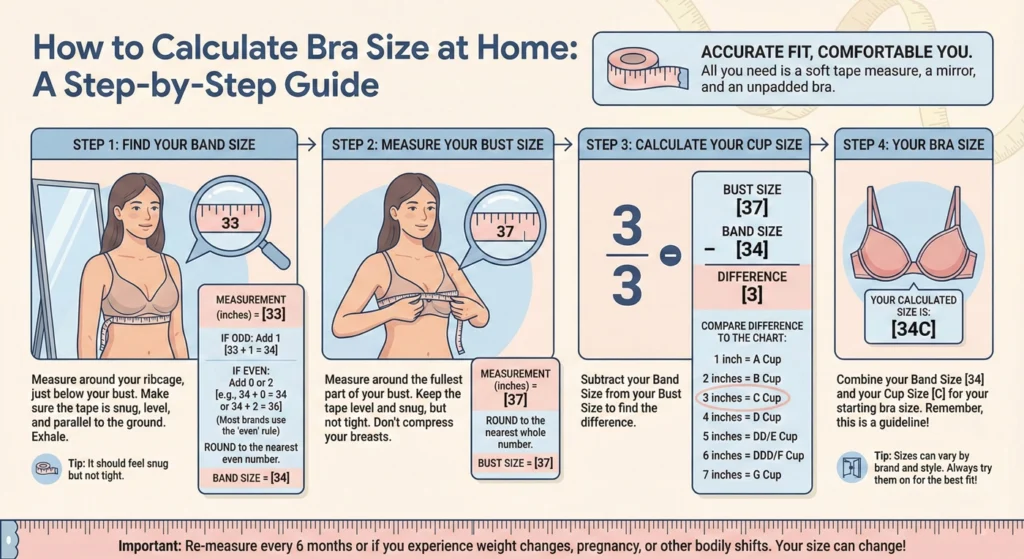
The “+4 Method” is Honestly Just… No
So you’ve probably heard this one before: measure around your ribcage under your boobs, and then—wait for it—add 4 or 5 inches to get your band size. If your measurement is even, add 4. If it’s odd, add 5.
This is what I call the “traditional” or “high street” method, and it’s everywhere. But here’s the thing: it’s super outdated. Like, this technique comes from way back when bra fabrics weren’t stretchy at all. Modern bras are made with elastic materials that actually, you know, stretch. So adding inches? Totally unnecessary.
What happens when you use this method? You end up with a band that’s way too loose (hello, riding up your back all day) and cups that are way too small (tissue spillage, anyone?). This is also part of what people call “matrix sizing”—basically limiting you to a super narrow range of sizes that fit almost nobody properly.
The Victoria’s Secret Method: When Profit Beats Precision
Oh, and then there’s the Victoria’s Secret approach. They measure above your bust (like, literally up by your armpits) to determine band size.
Real talk? This method is kinda BS. Fashion experts and lingerie specialists have called it out for years. Why? Because it often gives you a band size that’s 4, 6, or even 10 inches bigger than you actually need. And weirdly enough, this tends to make customers fit into VS’s limited size range. Convenient, right? 🙄
The correct bra size isn’t about squeezing you into what’s available—it’s about finding what actually fits your body.
Section 2: The Actually Accurate Way to Measure (I Promise It’s Not That Hard)
What You’ll Need to Get Started
Before we dive in, grab these things:
- A soft, flexible measuring tape (not the metal one from your toolbox, please)
- Ideally, wear a non-padded bra or just go braless for this
- A mirror helps, or better yet, recruit a friend or partner to help you keep the tape level
- Maybe put on some music because we’re taking six measurements and you might as well vibe with it
The Six-Measurement System (Trust Me, It’s Worth It)
Alright, so this is based on what the r/ABraThatFits community calls the ABTF method, and it’s legit the most accurate system I’ve found. Yes, you need to take six measurements. Yes, that sounds like a lot. But honestly, it takes like 5 minutes and the payoff is huge.
Quick note: You’ll want to do this without a shirt or bra on for the most accurate numbers.
Here’s what you’re measuring:
Loose Underbust: Wrap the tape around your ribcage just under your bust, but keep it loose—like barely staying up without falling off. This is your baseline.
Snug Underbust: Now wrap it comfortably snug. This should feel like how tight you’d actually want a bra band to feel. Not cutting into you, but secure. This is the magic number that determines your band size.
Tight Underbust: Take a deep breath out and pull the tape as tight as you possibly can. (It might feel weird, but we’re just checking maximum stretch here.)
Standing Bust: Stand up straight and measure around the fullest part of your bust. Pretty straightforward.
Leaning Bust: Okay, this one feels a little odd at first. Bend at the waist so you’re at a 90-degree angle with your boobs hanging down, then measure around the fullest part. This accounts for softer tissue and projection.
Lying Bust: Lie flat on your back and measure around the fullest part. This shows how your tissue moves and distributes.
Let’s Do Some Math (The Easy Kind, I Promise)
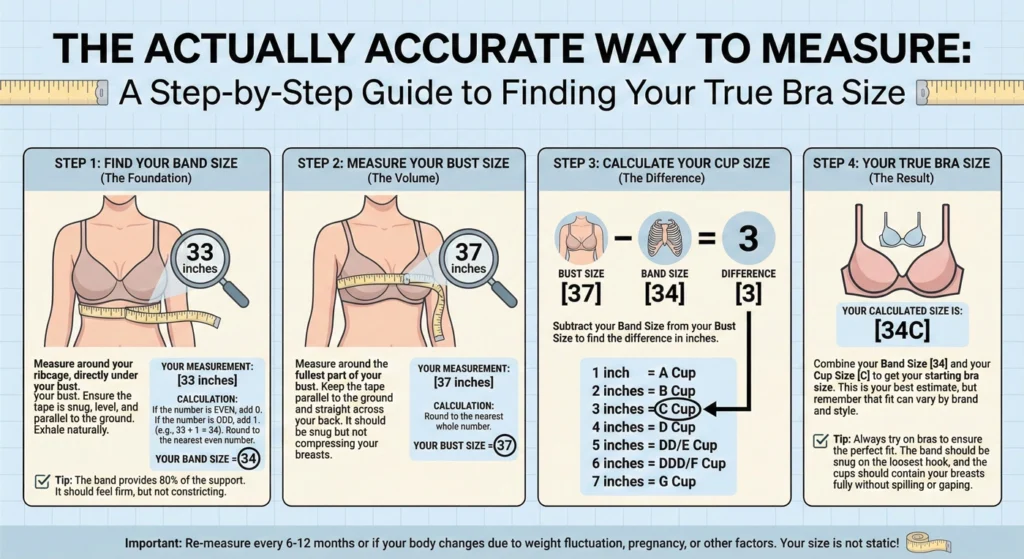
Step 1: Figure out your band size
Take your Snug Underbust measurement. If it’s an odd number, round up to the nearest even number. So if you measured 33 inches, you’re starting with a 34 band. That’s it. No weird adding of 4 inches, no measuring your armpits. Just the actual measurement of your actual ribcage.
Step 2: Calculate your cup size
Add up your three bust measurements (Standing + Leaning + Lying) and divide by 3 to get the average. Then subtract your band size from that average.
Step 3: Convert to a letter
Every inch of difference equals one cup size:
- 1 inch = A cup
- 2 inches = B cup
- 3 inches = C cup
- 4 inches = D cup
- 5 inches = DD/E cup
- And so on…
Pro tip: UK sizing is way more consistent than US sizing. A US G cup might be a UK F cup, so when you’re shopping online or using an accurate bra size calculator, make sure you know which system the brand uses.
Section 3: How to Know If Your Bra Actually Fits (The Ultimate Bra Fit Guide)

Okay, so you’ve got your measurements and ordered some bras. How do you know if they actually fit? Let me give you the checklist that professional fitters use.
The Band: Your True Support System
Here’s something that’ll surprise you: 80% of your support should come from the band, not the straps. Mind-blowing, right?
Good fit looks like this: The band sits horizontally around your body (no riding up in the back) and feels comfortably snug on the loosest hook. You should only be able to pull it away from your back about an inch, or fit two fingers underneath max.
Bad fit looks like this: The band rides up your back, creating that “frown” shape. Or it lifts up when you raise your arms. Either way, it’s too loose and you’re not getting proper support.
The Gore: That Little Piece Nobody Talks About
The gore is that little piece of fabric between the cups. In an underwire bra, it should tack—meaning it lies completely flat against your sternum.
If it’s floating or lifting away from your chest? Your cups are too small or the bra shape is wrong for you.
The Cups: The Goldilocks Zone
Your cups should fully contain all your breast tissue with no spillage and no gapping. Sounds simple, but here’s what to watch for:
Quadboob (also called double boob) is when tissue spills over the top, sides, or middle of the cup. This means you need to go up in cup volume.
Wrinkling or gaping means the cups are too big, or the shape doesn’t match your breast shape (we’ll get to that in a sec).
The Underwires: Following Your Natural Line
If you’re wearing an underwire bra, those wires should sit flat on your ribcage—not on any breast tissue—all the way around to your armpits. They should follow the natural curve where your breast meets your chest (called the breast root).
If the wires are digging into breast tissue or poking you in the armpit, the cup is probably too small or the wrong width.
The Secret Weapon: Scoop and Swoop
Okay, this is life-changing. Every single time you put on a bra, you need to do the “scoop and swoop.” Lean forward, reach into each cup, and literally scoop all your breast tissue from your sides and armpits forward into the cup.
This instantly smooths everything out and ensures you’re actually seeing how the bra fits. Sometimes a bra looks fine until you scoop and swoop, then suddenly you’ve got quadboob revealing that you need a bigger cup. It’s like the universal truth check for bra fitting.
Section 4: Next-Level Fitting Tips (Because Bodies Are Complicated)
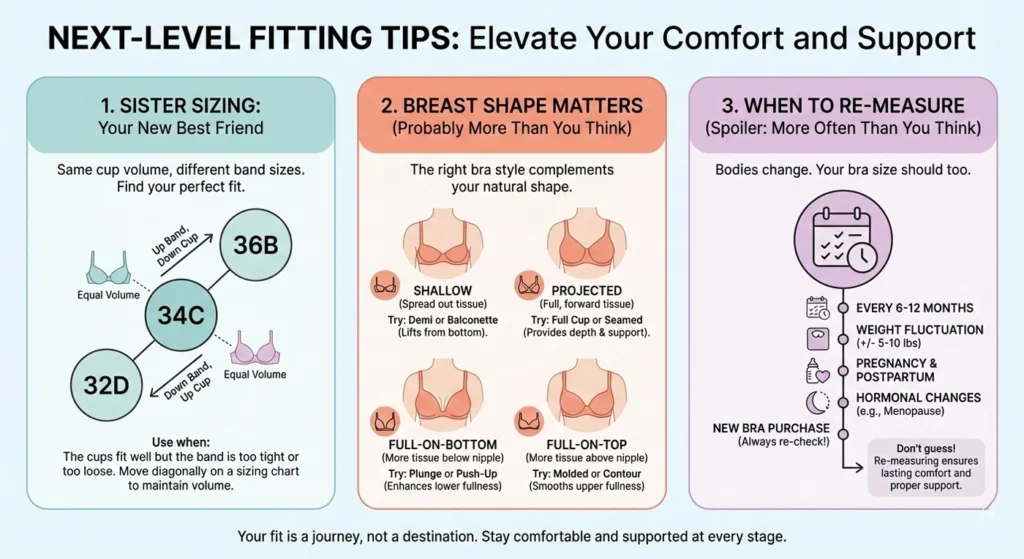
Sister Sizing: Your New Best Friend
So here’s a cool concept: sister sizes maintain the same cup volume but change the band size. This works because cup sizes are relative to the band—a 32D and a 34C actually have the same cup volume.
When to use it: Let’s say you try a 32D and the cups fit perfectly, but the band is too tight. Sister size up to a 34C. If the cups fit but the band is too loose, sister size down to a 30DD.
This is super helpful when shopping because not every brand carries every size, and sometimes you just need to adjust one element.
Breast Shape Matters (Probably More Than You Think)
Here’s the thing nobody tells you: bra sizes are just a starting point. The shape of the bra needs to match the shape of your breasts, or it’s never gonna fit right.
Projection is about how far your breasts stick out when supported:
- Shallow breasts have tissue spread out wider (think dinner plate). If you’re shallow, you might find that cups seem to cut in at the top even when the size seems right.
- Projected breasts stick out more from the chest (think drinking glass).
Fullness is about where most of your tissue sits:
- Full-on-top means more tissue above the nipple
- Full-on-bottom means more tissue below the nipple
Knowing your shape helps you pick bra styles that’ll actually work with your body instead of against it.
When to Re-Measure (Spoiler: More Often Than You Think)
Bodies are weird and wonderful and they change all the time. You can fluctuate by a full cup size just during your menstrual cycle. Weight changes, hormones, pregnancy, breastfeeding, aging—all of it affects your size.
Real talk: you should measure yourself or get fitted every six months to a year at minimum. If you notice your bras feeling uncomfortable or you’re experiencing any of those body changes I mentioned, measure more often.
Frequently Asked Questions
What are the signs my cups are too small?
The biggest giveaways are quadboob (tissue spilling over anywhere) and the gore not tacking (floating away from your chest). Both mean you need more cup volume. Try going up a cup size—or if the band is also loose, try sister sizing down for a tighter band with more cup volume.
Where should my support actually come from?
About 80% should come from the band. The straps are there for positioning and a little uplift, but they’re not the foundation. If your straps are digging into your shoulders, that’s actually a sign your band is too loose and not doing its job.
Do sizes change between brands?
Oh my gosh, yes. Bra sizing is not standardized at all, which is super frustrating. Different fabrics, cuts, and design styles mean a 34D in one brand might fit totally different than a 34D in another. This is why the bra fitting community recommends trying sister sizes and reading brand-specific reviews before ordering.
Conclusion: Your Best Fit is Out There
Look, finding your correct bra size is honestly a bit of a journey. There’s gonna be some trial and error, some returns, maybe some “why doesn’t this fit?!” moments. But starting with an accurate measurement method—like actually measuring your underbust instead of adding random numbers—puts you light years ahead of where most of us started.
A properly fitted bra should make you feel supported, comfortable, and confident. It shouldn’t hurt, shouldn’t leave deep marks, and shouldn’t make you want to rip it off the second you get home. Your bras should work with your body, not against it.
So grab that measuring tape, take those six measurements, and start your journey to finding a bra that actually fits. Your back, your shoulders, and your overall comfort will thank you. Plus, when you finally find that perfect bra? It’s like discovering a secret superpower. Everything fits better, you feel better, and you wonder why you spent so many years wearing the wrong size.
You’ve got this! 💪