
Look, let’s be real for a second. Your Grade Point Average (GPA) is basically this magical number that’s supposed to sum up your intelligence, work ethic, and how much you’re willing to torture yourself with hard classes. No pressure, right?
Here’s the thing though – even though the grading system has been getting roasted by educators for like a hundred years, every school still uses it. And not just uses it – they all use it differently. Some schools rock a 7-point scale, others swear by a 10-point system, and don’t even get me started on the 4-point and 6-point variations. It’s like everyone got together and decided to make GPA calculation as complicated as possible just for fun.
But here’s what I’m gonna do for you: I’m breaking down everything you need to know about weighted versus unweighted GPA, showing you exactly how to use a GPA calculator, and letting you in on the secret of how colleges actually look at your grades. Spoiler alert – it’s way more nuanced than you think.
Weighted vs. Unweighted GPA: What’s the Deal?

What’s the Difference Between Weighted and Unweighted GPA Anyway?
Okay, so there are basically two types of GPA that schools throw around, and understanding the difference is kind of crucial.
Unweighted GPA is the straightforward one. It’s typically on a 4.0 scale, and honestly? It’s pretty simple. You get an A, you get 4.0 points. Doesn’t matter if it’s in underwater basket weaving or AP Calculus BC – an A is an A is 4.0. Easy peasy.
Weighted GPA, on the other hand, is where things get spicy. This scale actually gives you credit for taking harder classes. It showcases your hard work and willingness to challenge yourself instead of coasting through easy courses. Weighted GPAs usually go beyond that 4.0 ceiling – we’re talking 5.0, sometimes even 6.0 territory.
Here’s how the weighting magic works: most schools add about 0.5 points for honors classes and a full 1.0 point for AP or IB courses. So that A in AP Chemistry? That’s not just a 4.0 – that’s a solid 5.0 on your weighted GPA.
Standard Grade Conversion Table (Your New Best Friend)

Alright, let me lay out the numbers for you so you can actually see what we’re talking about. This table is gonna be your go-to reference when you’re doing GPA calculation:
| Letter Grade | Standard GPA | Honors GPA | AP/IB GPA |
|---|---|---|---|
| A+ | 4.0 | 4.5 | 5.0 |
| A | 4.0 | 4.5 | 5.0 |
| A- | 3.7 | 4.2 | 4.7 |
| B+ | 3.3 | 3.8 | 4.3 |
| B | 3.0 | 3.5 | 4.0 |
| B- | 2.7 | 3.2 | 3.7 |
| C+ | 2.3 | 2.8 | 3.3 |
| C | 2.0 | 2.5 | 3.0 |
| C- | 1.7 | 2.2 | 2.7 |
| D+ | 1.3 | 1.8 | 2.3 |
| D | 1.0 | 1.5 | 2.0 |
| F | 0.0 | 0.0 | 0.0 |
See how that works? The same B grade is worth way more when you’re sweating through an AP class versus a regular one.
Step-by-Step: How to Calculate Your Weighted GPA
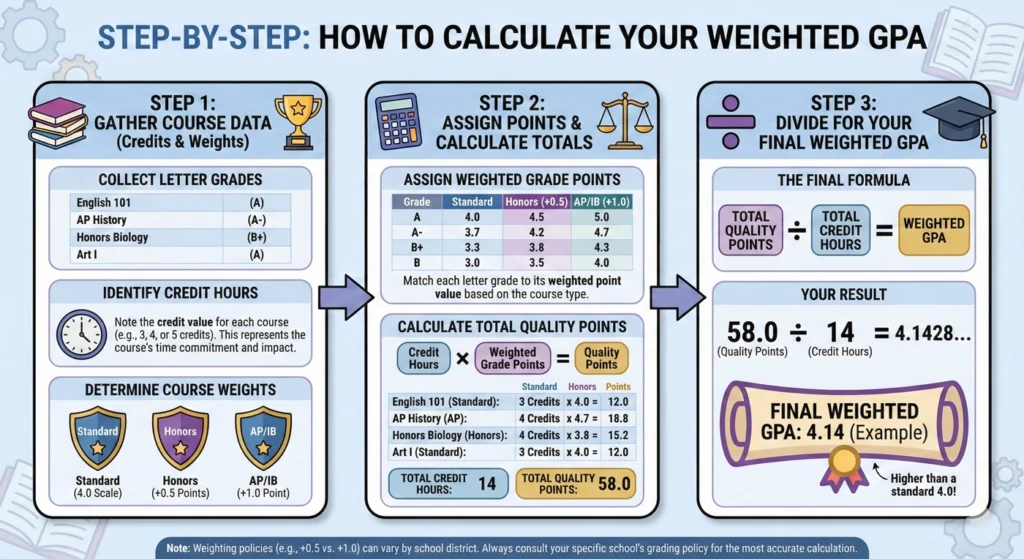
Method 1: The Class-by-Class Calculation
Okay, grab a calculator (or your phone, let’s be honest) and let’s walk through this together. Here’s how you calculate your weighted GPA from scratch:
Step 1: Convert Each Final Grade
Go through every single class and convert your letter grade to the appropriate GPA points based on whether it was standard, honors, or AP/IB. Use that handy table I just showed you.
Step 2: Keep Track of Course Levels
This is important – don’t mix up which classes were which. Regular Algebra II and AP Calc are not the same thing in this equation.
Step 3: Sum Everything Up
Add all those converted GPA points together. Yes, all of them. I know, math is hard, but you got this.
Step 4: Divide by Total Classes
Count how many classes you took total, then divide your sum by that number. Boom – there’s your weighted GPA.
Method 2: The Sorted-Classes Shortcut (If You Already Know Your Unweighted GPA)
If you’ve already got your unweighted GPA handy, there’s actually a faster way to do this:
Step 1: Count up how many standard classes, honors classes, and AP/IB classes you took separately.
Step 2: Calculate your weighted sum using this formula:
Unweighted grade sum + (0.5 × number of honors classes) + (1.0 × number of AP/IB classes)
Step 3: Divide that weighted sum by your total number of classes.
Real Example: Let’s Calculate Jane’s GPA
Let me show you how this actually works with a real person (okay, a made-up person, but still). Meet Jane Doe, who’s been crushing it academically.
Jane took 15 classes total:
- Some were regular courses
- Some were honors
- Some were AP classes
When we convert all her grades and add them up, we get a weighted sum of 59.4 points. Now we just divide: 59.4 ÷ 15 classes = 4.0 weighted GPA.
Pretty solid, Jane! That 4.0 shows she’s been challenging herself with tougher courses while maintaining strong grades.
The Role of GPA in Admissions: It’s Complicated

Do Colleges Use Weighted or Unweighted GPA? (Plot Twist: Both and Neither)
Here’s where things get really interesting. When you’re filling out the Common App, you’ve gotta report your GPA accurately – whatever your school put on your transcript. But here’s the kicker: most colleges don’t actually use that number as-is.
Nope, they often recalculate your GPA using their own special formula. Why? Because they want to compare apples to apples, not apples to oranges to those weird apple-pear hybrid fruits.
Take the University of Georgia, for example. They recalculate everyone’s high school GPA by adding a full 1.0 weight to every single AP or IB grade on a 4.0 scale. They’re basically saying “we trust our own math more than your school’s math,” which, honestly? Fair enough.
These recalculations usually focus on core academic subjects – we’re talking math, science, English, social studies, and world languages. That pottery elective? Probably not making the cut for their GPA calculation, sorry.
The bottom line is you need to give them accurate data and context so admissions officers can actually understand what you accomplished in high school.
Academic Rigor: More Important Than the Number Itself
Here’s something that’ll blow your mind: colleges care more about what classes you took than your actual GPA number.
I’m serious. A student with a 3.8 GPA who loaded up on AP classes and challenged themselves? That can look way more impressive than someone with a perfect 4.0 who only took the easiest classes possible. Admissions officers are savvy – they can see right through grade inflation.
They’re also looking at your GPA trajectory. Did you start rough but finish strong? That shows growth, adaptability, and resilience. Those are the character traits that actually matter in college when things get tough.
The Truth Bomb: Test Scores Actually Predict Success Better
Okay, I’m about to hit you with some counterintuitive research that might make you feel some type of way. Ready?
High school GPA does a pretty lousy job of predicting how well you’ll actually do in college. Yeah, I know – all that stress for nothing, right?
But here’s what does predict college success: SAT and ACT scores. Even when comparing students with identical high school GPAs, standardized test scores show substantial predictive power for first-year college performance. I’m not saying GPA doesn’t matter – it definitely does for getting admitted – but it’s not the crystal ball everyone thinks it is.
Frequently Asked Questions
What’s the highest possible GPA?
The highest unweighted GPA is 4.0 – that’s the ceiling. But with weighted GPA scales? Sky’s the limit, baby. Many schools max out at 5.0 for someone taking all AP classes and acing them, though some systems even go to 6.0.
Is cumulative GPA the same as semester GPA?
Nope, they’re different animals. Your semester GPA is just for one semester, while your cumulative GPA is the average of literally every grade you’ve gotten throughout your entire high school (or college) career. Think of cumulative GPA as the ultimate long game.
How do colleges evaluate high school GPA alongside test scores?
Colleges are looking for balance. They might recalculate your GPA using their own system, and they’re definitely checking out both your grades and your SAT/ACT scores. Interestingly, those test scores might actually be a stronger predictor of how you’ll do freshman year than your high school GPA. Don’t shoot the messenger – that’s just what the research shows.
What GPA is considered low for top universities?
Real talk? For Ivy League schools and other top-tier universities, the average admitted student usually has at least a 3.9 unweighted GPA. Anything under 3.9 is gonna make admissions officers raise an eyebrow. A 3.0 GPA? That’s probably not gonna cut it for these uber-competitive schools, unless you’ve cured cancer or something equally impressive.
The Bottom Line: Your Academic Journey Is More Than a Number
Look, here’s the deal: GPA is an imperfect metric. It’s been criticized forever, and it’s not going anywhere anytime soon. But if you’re aiming for highly selective or Ivy League schools, you need to be rocking a 3.9 or higher (unweighted). That’s just the reality.
My advice? Focus on keeping that GPA high while challenging yourself with rigorous coursework. Don’t just pad your GPA with easy A’s – admissions officers can see right through that strategy. They want to see the “whole student,” and strong grades show maturity, planning skills, and follow-through.
And remember, your GPA matters beyond just college applications. Scholarships, internships, and even some jobs will want to see those numbers. So yeah, it’s worth caring about, even if the system is kinda broken.
Now go forth and calculate that GPA with confidence. You’ve got this!