
So you’re planning a flight and wondering exactly how long you’ll be up there in the clouds? Whether you’re a student pilot working on your first cross-country or a seasoned aviator planning a private jet trip, getting your flight time right is absolutely crucial. And honestly? It’s way more interesting than you might think.
Let me break down what flight time actually means. It’s the total duration you spend piloting an aircraft, starting from the moment your plane first moves under its own power (think: when you release those brakes and start taxiing) until you come to a complete stop after landing. Pretty straightforward, right?
But here’s the thing – accurate flight time calculations aren’t just about knowing when you’ll arrive. They’re the backbone of everything in aviation. We’re talking proper fuel planning (because running out of gas at 10,000 feet is, y’know, not ideal), ensuring you show up on time, keeping costs under control, and making sure your passengers aren’t sitting around wondering where you are. A flight time calculator is basically your best friend when it comes to nailing these numbers.
Fun fact: this is actually one of the highest searched keywords in the aviation space. Why? Because every pilot, from beginners to pros, needs to know how to calculate flight time properly. This guide’s got everything you need to fly smart and embrace those beautiful skies with confidence.
The Foundational Formulas for Manual Flight Time Calculation
Alright, let’s get into the nitty-gritty. Don’t worry – the math here isn’t rocket science (even though we’re dealing with planes).
The Basic Distance and Speed Equation
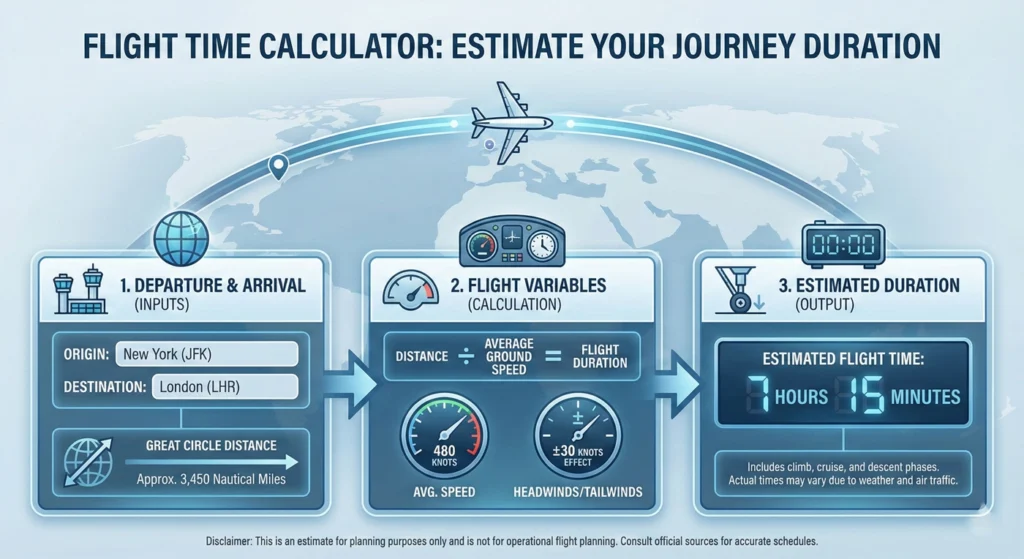
Here’s where it all starts. To figure out your flight duration, you really only need two pieces of info: how far you’re going and how fast you’re flying. Simple as that.
The formula? Flight Time = Distance / Speed
Now, before your eyes glaze over, let me give you a real-world example. In aviation, we usually measure distance in nautical miles (NM) and speed in knots (which is basically nautical miles per hour – the aviation world loves keeping things in the same units).
So let’s say you’re flying a Cessna Citation CJ4 (nice ride, by the way) and you need to cover 900 nautical miles. This baby cruises at about 451 knots. Plug those numbers in: 900 ÷ 451 = approximately 1.99 hours. So you’re looking at roughly 2 hours of flight time. Easy peasy!
This basic calculation is what most flight travel time calculators use as their foundation. Once you understand this principle, you’re already ahead of the game.
Adjusting for Wind Conditions: Calculating Ground Speed
Now here’s where things get a bit more real. Anyone who’s flown knows that wind can be your best friend or your worst enemy up there.
Got a tailwind? Sweet! You’re getting pushed along, making better time than expected. Flying into a headwind? Well, buckle up because you’re gonna be up there longer than you planned. Wind affects your flight time significantly, and that’s why we need to calculate something called ground speed.
The formula’s pretty intuitive: Ground Speed = True Airspeed (TAS) – Headwind (or + Tailwind if you’re lucky). This adjustment gives you a way more accurate estimate than just using your airspeed indicator.
Quick pro tip for estimating True Airspeed: here’s some mental math that’ll make you look smart at the airport. Add 2% of your Calibrated Airspeed (CAS) for every 1,000 feet of pressure altitude. It’s not perfect, but it’ll get you in the ballpark when you’re doing quick calculations in your head.
Understanding how wind impacts your ground speed is essential for any accurate flight time calculation. It’s the difference between showing up when expected versus having some explaining to do.
Essential Tools for Pilots: Mechanical and Digital Calculators
Let’s talk gear. Because while knowing the formulas is great, having the right tools makes everything so much easier.
Mastering the E6B Flight Computer (The “Whiz Wheel”)
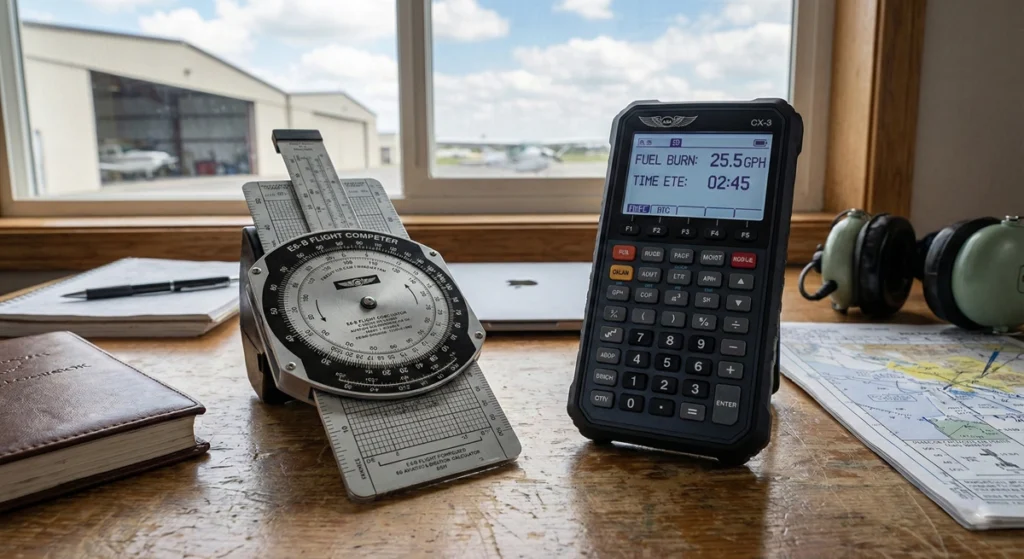
Ah, the legendary E6B – affectionately known as the “whiz wheel” in pilot circles. If you’re serious about flying, this circular slide rule calculator needs to be in your flight bag. Yeah, it looks like something from the analog age (because it is), but trust me, this thing is gold for cross-country flight planning.
The E6B helps you estimate flight times, fuel burn, altitude corrections, headings, and wind corrections. It’s like having a tiny aviation computer in your pocket that never needs batteries.
Here’s a quick example: let’s say you’re cruising at 120 knots and need to cover 48 nautical miles. Spin that whiz wheel, and boom – it shows you’ll need about 24 minutes to cover that distance (not counting wind correction, which you’d factor in next).
If you’re shopping for one, check out ASA’s aluminum E6B – it’s durable and classic. Or if you want something a bit more user-friendly, the ASA Color E6B uses different colors to mark various functions, which honestly makes life easier when you’re trying to figure things out in a bumpy cockpit.
Top Digital Flight Planning Resources
Okay, okay – I love my E6B, but let’s be honest: we live in the digital age, and there are some incredible apps and websites that make flight time calculations even easier.
ForeFlight is basically the gold standard for pilots these days. Seriously, ask any pilot what’s on their iPad, and ForeFlight’s probably there. It gives you time estimates, full weather briefings, fuel consumption data, and you can even file your flight plans directly through it. The cool thing? When you plug in your specific aircraft details, it uses that actual performance data to give you super accurate estimates. It’s like having a flight time calculator that knows exactly what you’re flying.
SkyVector is another awesome resource, especially if you want something free. You just input your departure and arrival airport codes, throw in your speed, and it calculates your Estimated Time Enroute (ETE). It’s straightforward and gets the job done.
And then there are tons of online flight time calculators out there. Most of them work similarly – you enter airport codes (usually IATA identifiers), your airspeeds (ground speed or true airspeed), and wind factors. The calculator does the heavy lifting, and you get your answer in seconds.
The digital tools are especially handy because they can pull real-time weather data and give you current wind information, making your calculations way more accurate than doing it all by hand.
Calculating Flight Time in Specific Aviation Niches
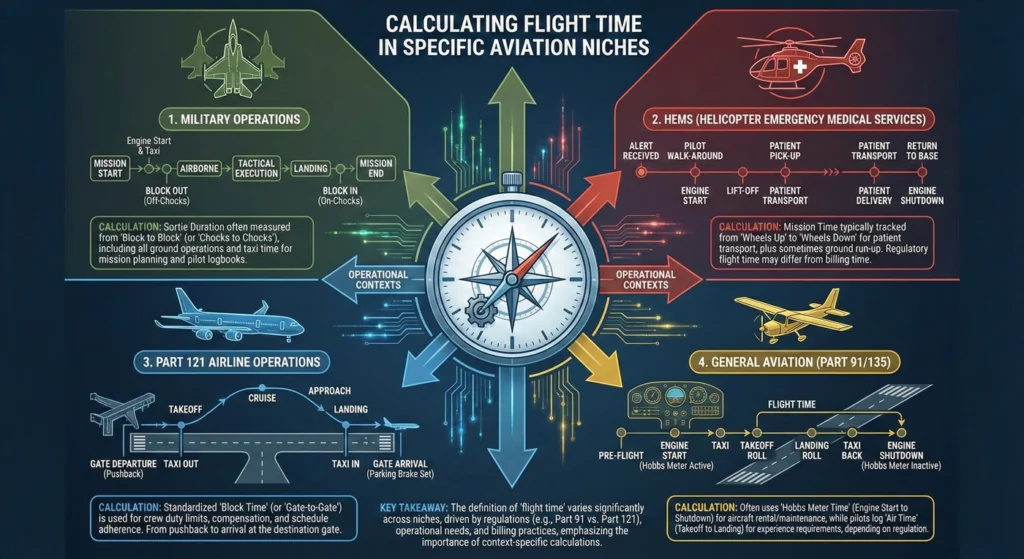
Not all flying is created equal. Let’s dive into some specialized scenarios where flight time calculations get a bit more specific.
Private Jet Flight Planning Accuracy
If you’re flying private (lucky you!), accurate time calculations become even more critical. We’re talking serious money here – fuel costs, crew scheduling, landing fees, ground handling arrangements. Everything needs to be timed perfectly.
Private plane flight calculators are sophisticated pieces of software that consider way more than just distance and speed. They factor in your aircraft’s specific performance characteristics – climb gradients, cruise speeds, descent profiles – plus air traffic routing and airport procedures.
Here’s how to nail your private jet flight planning:
Step 1: Determine Your Route – Use ICAO codes for your departure and arrival airports, and map out any waypoints along the way. This isn’t just a straight line; you’re following actual air routes.
Step 2: Select Your Aircraft Type – This is huge. Choose your exact jet model (say, a Falcon 2000LX or Citation M2) because each bird has its own performance data. A Gulfstream climbs differently than a Learjet, and that affects your total flight time.
Step 3: Input Current Conditions – Plug in the weather, especially wind speeds and directions. Also check for any temporary flight restrictions (TFRs) that might make you adjust your route.
Step 4: Review and Adjust – Compare your calculated results against your experience on similar routes. Local knowledge counts for a lot. If you’ve flown this route before and it always takes longer than calculated, factor that in.
The beauty of specialized private jet calculators is they account for the real-world stuff that basic formulas miss.
Calculating Flight Duration for Drones (UAS)
Switching gears completely – let’s talk drones! If you’re into unmanned aerial systems (UAS), flight time calculation is probably one of your top concerns, especially when you’re shopping for or building a drone.
For drones, it’s all about the battery. Here are the core inputs you need:
Battery Capacity (mAh) – This is how much energy your battery stores. Bigger number = longer flight time, generally speaking.
Reserve Percentage – Here’s something super important: the “80% rule.” Never discharge your LiPo batteries below 20% of total capacity. Seriously, if you do, you can permanently damage them. So when calculating flight time, you’re really working with 80% of your battery’s capacity.
Average Amp Draw (A) – This is the current your motors pull to maintain a stable hover. It depends on your drone’s all-up weight (AUW) and your motor/prop setup.
But wait, there’s more! Your actual flight time can vary wildly based on how you fly. FPV racing, for example, uses 3 to 4 times as much juice as just hovering. And if you’re battling strong crosswinds? Your flight time can drop by up to 50%. Crazy, right?
The point is, drone flight time calculations need to account for your flying style and conditions. That’s why experienced drone pilots always test their setups before doing anything important.
Professional Logging and Time Zone Considerations

Now let’s talk about some of the practical stuff that matters for professional pilots and anyone building hours toward certifications.
Accounting for Time Zone Shifts
Long-haul flights get interesting when you start crossing time zones. And if you’ve ever flown coast-to-coast or internationally, you know that calculating actual flight duration while dealing with time zones can mess with your head.
Here’s the process: note your departure time and arrival time in local time. Then account for the time zone difference (you’ll either add or subtract hours depending on which direction you’re going). Finally, subtract your adjusted departure time from the arrival time to get the actual flight duration.
Pro tip? Use UTC (Coordinated Universal Time) for your calculations. It’s the standard time in aviation for a reason – no time zones to worry about, no Daylight Saving Time weirdness. It just makes everything cleaner.
For example, if you depart Los Angeles at 10:00 AM PST and arrive in New York at 6:30 PM EST, you didn’t fly 8.5 hours. With the 3-hour time difference, you actually flew 5.5 hours. Using UTC from the start would’ve made that instantly clear.
Flight Hours Required for Certification and Accurate Logging
Let’s talk about the thing every pilot is constantly tracking: flight hours. This is literally how experience is measured in aviation. Your logbook tells the story of your aviation journey.
According to 14 CFR § 61.51, you must log flight time if you’re going to use those hours toward certifications, ratings, endorsements, or currency requirements. This isn’t optional – it’s the law.
Here are the biggies for US pilot certifications:
Private Pilot (Airplane/Helicopter) – You need 40 total hours, with at least 30 hours of instructor time and 10 hours solo. This is your gateway to flying for fun.
Commercial Pilot (Airplane, Part 61) – Now we’re talking 250 hours total. This is when you can start getting paid to fly.
Commercial Airline Pilot – The big leagues: 1,500 hours. This is what you need to sit in the right seat of a commercial airliner.
Some logbook best practices from someone who’s been there: log your time immediately after each flight. Don’t wait! Memory fades fast, and you want accurate records. Track hours to the nearest tenth (0.1) for FAA purposes. And invest in a quality logbook – physical or digital – because this document is officially part of your aviation career.
Every tenth of an hour counts when you’re working toward those certification minimums. A good flight time calculator helps ensure you’re tracking everything accurately.
Making You a Smarter, Safer Aviator
So there you have it – everything you need to know about calculating flight time. Whether you’re using a basic formula on the back of an envelope, spinning your trusty E6B, or tapping away at ForeFlight on your iPad, understanding these calculations is genuinely powerful knowledge.
Why? Because accurate flight time calculation isn’t just about math – it’s about safety. It’s about being prepared. It’s about knowing exactly what you’re getting into before you even start the engine. That’s what separates confident, professional pilots from the rest.
The more you practice these calculations, the more intuitive they become. Eventually, you’ll be doing rough estimates in your head before you even pull out a calculator. That’s when you know you’ve really got it down.
If you’re working toward your Private Pilot certificate, studying for your Instrument Rating, or just want to up your aviation game, keep diving deeper into flight planning. Check out resources for quality logbooks, flight computers, and training materials. The investment in knowledge and proper tools always pays off in the sky.
Remember: every flight starts with good planning, and good planning starts with knowing exactly how long you’ll be up there. Master your flight time calculations, and you’re well on your way to becoming the kind of pilot everyone wants to fly with.
Now get out there and embrace those skies – but do it smart, do it safe, and do it with confidence. Happy flying!