
So here’s the deal: a calorie estimator (or calculator, whatever you want to call it) is basically your best friend when you’re trying to figure out what your body actually needs. It’ll give you a solid reality check on your current maintenance calories, how much of a deficit you need if you’re trying to drop some weight, and even warn you about potential health stuff like your BMI. The cool part? The newest ones use Artificial Intelligence to give you real-time, dynamic tracking instead of just spitting out some static number and calling it a day. Trust me, it’s a total game-changer.
- Understanding the Foundation: What Do Calorie Estimators Calculate?
- The AI Revolution: Smart Trackers
- Beyond Calories: Essential Metrics Calculated by Advanced Estimators
- The Accuracy Challenge: Limitations and Expert Adjustments (E-A-T Signal)
- Optimizing Your Journey: Leveraging Estimators for Sustainable Health
- Conclusion: Your Next Step in Calorie Tracking
Understanding the Foundation: What Do Calorie Estimators Calculate?
Static Calculation: The Traditional Calorie Calculator
Alright, let’s start with the basics. Traditional calorie calculators are pretty straightforward—they’re static tools that use mathematical formulas (fancy ones like Mifflin-St Jeor, if you want to sound smart at parties) to give you a one-time estimate of how many calories you burn daily.
You punch in some info—your age, height, weight, whether you’re male or female, and how active you are—and boom, it gives you a number. Usually, you’ll get a high estimate, a low one, and an average. It’s like getting three different opinions from the same calculator, which honestly can be a bit confusing. But hey, it’s a starting point.
The thing is, these tools rely on that static mathematical formula, so once you get your number, that’s it. It doesn’t adjust or learn anything about you over time. It’s kinda like using MapQuest directions from 2005 instead of Google Maps with live traffic updates.
Dynamic Calculation: The TDEE Estimation Algorithm (The Game Changer)
Now we’re talking! Let me introduce you to TDEE—Total Daily Energy Expenditure. Basically, it’s the total number of calories your body burns in a day doing everything: breathing, walking, scrolling through Instagram, arguing with people on the internet, all of it.
Here’s where things get interesting. Dynamic TDEE estimation algorithms—like the ones apps such as MacroFactor use—are an absolute game changer. Seriously. Instead of giving you one number and bouncing, these tools actually track your progress over time and adjust based on your actual energy output.
Why’s this so awesome? Because your weight can fluctuate 3-4 pounds in a single day depending on water retention, what you ate, whether Mercury is in retrograde—you name it. A TDEE calculator looks at your trend weight instead of freaking out over daily ups and downs. This makes it way easier to see if you’re actually making progress during maintenance or even during a lean bulk (when you’re trying to gain muscle without packing on too much fat).
Trust me, once you use a dynamic tool, going back to static calculators feels like trading in your smartphone for a flip phone.
The AI Revolution: Smart Trackers

AI Calorie Counters: Eliminating Manual Friction
Okay, real talk: the biggest reason people quit tracking their food isn’t because they’re lazy—it’s because manually logging every single thing you eat is a massive pain in the butt. I mean, who wants to spend 10 minutes searching through MyFitnessPal’s database trying to figure out which of the 47 entries for “grilled chicken breast” is actually correct?
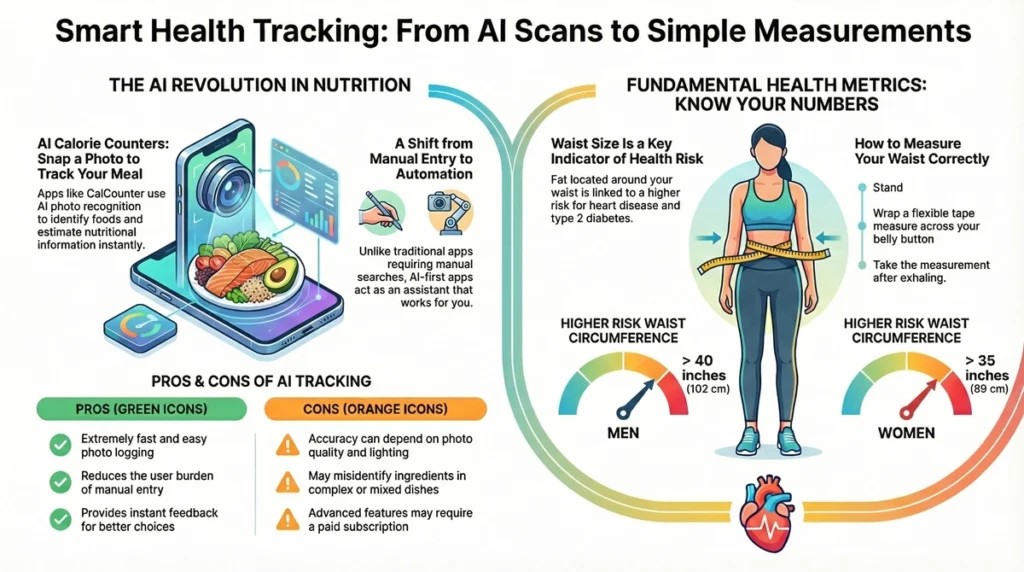
That’s where AI-powered tools like CalCounter come in and basically save your sanity. These apps eliminate all that friction by using photo recognition (you literally just snap a pic of your food), keyword search that actually works, and even chat-based logging where you can just type “had a turkey sandwich” and it figures it out.
The whole objective here is to automate the boring stuff, make tracking more accurate, and reduce how much effort you have to put in. Because let’s be honest—the easier something is, the more likely you are to actually stick with it. And sticking with it is literally the whole game when it comes to weight loss or maintenance.
Head-to-Head: AI Tracking vs. Traditional Databases
So how do these AI apps stack up against the old guard like MyFitnessPal?
Well, traditional apps have massive, user-generated databases. Which sounds great until you realize that “user-generated” often means “wildly inconsistent and sometimes completely wrong.” Ever looked up a food and found entries ranging from 200 to 600 calories for the exact same thing? Yeah, that’s the problem.
AI-native apps are trying to fix this with AI-verified databases and a photo-first approach. Instead of trusting that random user “FitnessFan2012” entered accurate nutrition info for homemade lasagna, the AI analyzes your actual food photo and cross-references verified data.
Here’s the thing: we humans are notoriously terrible at estimating portion sizes. Like, embarrassingly bad. Studies show people consistently underestimate their calorie intake, especially with stuff like oils, dressings, and portion sizes. AI’s trying to fill that gap and catch the human error we all make when we think “eh, that’s probably about a cup” when it’s actually closer to two.
Beyond Calories: Essential Metrics Calculated by Advanced Estimators

Calorie Deficit and Weight Loss Feasibility
Here’s something cool: modern estimators don’t just tell you how many calories to eat—they’ll actually tell you if your weight loss goal is realistic, challenging, or straight-up dangerous given your timeline.
Let’s say you want to lose 20 pounds in a month. A good calorie deficit calculator will basically wave a red flag and be like, “Whoa there, cowboy. That’s not happening safely.” It’ll show you exactly how big of a deficit you’d need and whether that’s sustainable or if you’d literally need to eat nothing and run marathons daily.
Plus, these tools will calculate how many pounds you need to lose to hit a normal BMI score. It’s like having a reality check built right in, which honestly? Pretty helpful when setting your weight loss goal. Because let’s face it, we’ve all had unrealistic expectations at some point.
Protein Needs and Muscle Maintenance (Protein Calculator)
Okay, protein talk time. Once you hit 30, your body starts losing muscle mass if you’re not actively working to maintain it. Fun, right? (Spoiler: not fun.)
Good calorie estimators will calculate your protein needs based on your age and goals. This is super important because protein isn’t just for bodybuilders—it’s crucial for everyone who wants to, you know, maintain their muscle as they age.
Now, full disclosure: there’s some debate about how much protein is ideal. Some sources say going super high on protein can strain your kidneys, especially if you already have kidney issues. So don’t go chugging five protein shakes a day without checking with your doctor first.
Body Mass Index (BMI) and Waist Circumference
Ah, BMI. Everyone’s favorite controversial health metric. Look, I’ll be straight with you: BMI is kind of a dated, biased measure. It doesn’t account for muscle mass, bone density, or a bunch of other stuff. That’s why a jacked athlete might technically be “overweight” according to BMI even though they’re in incredible shape.
But here’s the thing—a BMI calculator is still useful as a quick, inexpensive screening tool. It’s not the whole picture, but it’s part of the puzzle.
What I’d recommend is tracking your waist circumference alongside BMI. Belly fat is particularly associated with health risks, so measuring around your waist gives you another data point about your overall body composition and potential weight-related health problems.
Think of it like checking multiple weather apps before deciding whether to bring an umbrella. More data = better decisions.
The Accuracy Challenge: Limitations and Expert Adjustments (E-A-T Signal)
The Problem of Complex Meals and Bias
Alright, let’s get real about accuracy for a second. While AI is awesome and definitely improving, it’s not perfect. It really struggles with complex, mixed dishes—stuff like casseroles, stir-fries, or grandma’s mystery stew where you have no idea what’s in there.
Hidden ingredients are another problem. That “healthy” salad at a restaurant? Probably has way more oil and sugar than you think. AI can’t see the tablespoon of butter the chef added or the sugar in the dressing unless it knows exactly what recipe was used.
And don’t even get me started on non-Western cuisines. A lot of AI tools are biased toward Western foods because that’s what most of their training data includes. So if you’re eating Ethiopian, Vietnamese, or Indian food regularly, the accuracy might be hit or miss.
Academic reviews show AI accuracy ranging from about 74% to over 99%, depending on the tool and what you’re tracking. So yeah, there’s still some variability there.
When Dynamic Algorithms Seem Wrong (MacroFactor Case Study)
Here’s a fun real-world example that’ll make you question everything: someone using MacroFactor eliminated about 3 hours of physical activity per day (we’re talking 300-500 calories worth), and their TDEE calculation barely changed. Like, what?
This is where even the best algorithms can seem weird. Your body is complex, and there are tons of factors at play—metabolic adaptation, changes in non-exercise activity (like if you subconsciously start moving less), sleep quality, stress levels, and more.
The takeaway? Even with dynamic TDEE estimation—which is still the best option out there—you need to remember that these are estimates. Sometimes the algorithm “doesn’t always make sense” because our bodies are weird and don’t always follow perfect mathematical models.
Don’t throw your phone across the room if the numbers seem off. Just adjust, keep tracking, and remember it’s all about long-term trends, not day-to-day perfection.
Optimizing Your Journey: Leveraging Estimators for Sustainable Health
Core Strategies for Success
Okay, here’s the golden rule: if you’re honest about logging your food and you actually follow the app’s recommendations, you WILL achieve your goals. Like, it’s pretty much guaranteed. The only way it doesn’t work is if you’re lying to yourself (logging two cookies when you ate six) or ignoring what the data’s telling you.
Here’s my favorite strategy: use your estimator to find your current calorie burn first. Just track normally for a week or two without trying to change anything. Once you know your baseline, then start adding small habit changes instead of going nuclear with your diet.
What kind of changes? Simple stuff like taking the stairs instead of the elevator, parking farther away, going for a 15-minute walk after dinner. These incremental additions to your activity level add up way faster than you’d think, and they’re way more sustainable than trying to suddenly work out two hours a day.
Here’s another pro tip: start thinking about food in terms of calories per gram. This helps you figure out which foods give you the most bang for your buck—meaning you can eat more volume and feel fuller while staying within your calorie budget. A huge bowl of vegetables? Low calories per gram. A handful of nuts? High calories per gram. Both are healthy, but one will fill you up way more for the same calorie “cost.”
This kind of micro-management might sound tedious, but honestly, it makes long-term adherence so much easier because you’re not constantly hungry and miserable.
Conclusion: Your Next Step in Calorie Tracking
So here’s the bottom line: modern AI calorie estimators are pretty much essential if you want to improve your long-term adherence to any nutrition plan. They take you beyond the tedious manual logging that makes everyone want to give up after three days, and they give you dynamic, personalized data that actually helps.
Whether you’re trying to lose weight, maintain, or do a lean bulk, having a solid calorie estimator in your toolkit makes everything easier. The AI features, the dynamic tracking, the reduced friction—it all adds up to a better experience and better results.
Now, before you go making any significant diet changes, please talk to a medical professional. Seriously. I’m just some person on the internet sharing info—your doctor actually knows your health history and can give you personalized advice.
And if you’re ready to dive in? Check out tools like Calorie Calculator Cloud to find a dynamic calorie calculator that’ll simplify your journey. Your future self (the one who actually stuck with their goals because tracking didn’t suck) will thank you.
Trust me, once you go AI-powered, you never go back to manually searching for “medium apple” in a database of 47 entries. Life’s too short for that nonsense.